Emerald Ash Borer in Knoxville: How to Identify, Protect & When to Remove Ash Trees
If you have an ash tree in your yard, this guide could literally save you thousands of dollars and keep your family out of harm’s way. The Emerald Ash Borer in Knoxville has already wiped out tens of millions of ash trees across North America, and Knox County has been ground zero for the East Tennessee outbreak since 2010.
Most homeowners we visit have no idea their tree is even an ash, let alone that it is being eaten alive from the inside. By the time the symptoms become obvious, the tree is usually too far gone to save. The window for action is narrower than people realize, and missing it has real consequences.
The Knoxville tree experts at Whites Tree Services have removed hundreds of EAB-killed ash trees across Knox, Loudon, and Blount counties. We have also helped homeowners save healthy trees with timely treatment. This guide walks through everything we have learned: how to spot it, what to do about it, and how to make the right call when treatment is no longer an option.
Read it carefully. If you act on what is in here, you might save a tree. If you ignore it, you might lose one through your roof.
What Is the Emerald Ash Borer (and Why Knoxville Should Care)
The Emerald Ash Borer (Agrilus planipennis) is a small, metallic green beetle native to East Asia. Adults are about half an inch long, slender, and bullet-shaped. They look almost too pretty to be a problem, which is exactly the issue.
Adult beetles do almost no damage on their own. They feed on ash leaves, mate, and lay eggs in bark crevices. The destruction comes from the larvae, which hatch out and tunnel into the layer just beneath the bark called the cambium.
That cambium layer is the highway that moves water and nutrients up and down the tree. EAB larvae chew zigzag tunnels through it, called galleries, that look like winding S-shapes when you peel back loose bark. Each gallery cuts off another section of the tree’s circulation system. Multiply that by hundreds or thousands of larvae, and the tree starves to death from the inside.
| The EAB Lifecycle in One Paragraph Adults emerge in late spring (typically late May through July in Knoxville).Females lay eggs in bark crevices throughout summer.Eggs hatch within 2 weeks, and larvae burrow under the bark.Larvae feed under the bark for the rest of summer and fall, creating S-shaped galleries.They overwinter as larvae just under the bark.In spring, they pupate and chew their way out, leaving D-shaped exit holes.The cycle repeats, with each new generation killing more of the tree. |
From the time EAB arrives in a healthy tree to the time the tree is dead is typically 2 to 4 years. In stressed trees, it happens faster. We have seen ash trees go from looking fine to completely dead in just 18 months.
How EAB Got Here and Where It’s Hitting Hardest
EAB was first detected in Detroit in 2002, almost certainly arriving in shipping crates from Asia. From there, it has spread to over 35 states and several Canadian provinces. The main vector is moving infested firewood and nursery stock, which is why “Don’t Move Firewood” campaigns exist all over the country.
The first confirmed Tennessee detection came in Knox County in 2010, near Interstate 40. That timing matters because it gave EAB a 15-year head start in our area before most homeowners even knew it existed.
Today, EAB has been confirmed in 66 of Tennessee’s 95 counties. East Tennessee has been hit especially hard. Drive any wooded stretch of I-40, I-75, or Pellissippi Parkway and look for tall, gray, dead trees standing among the green ones. Most of those are ash trees that have already lost their fight with EAB.
Within Knoxville proper, we see the worst infestations along major highway corridors and in older neighborhoods that have a lot of mature ash trees. Sequoyah Hills, Holston Hills, Bearden, Farragut, West Knoxville, and the Lenoir City area all have major EAB pressure right now.
Step 1: Confirm You Actually Have an Ash Tree
Before you start panicking about EAB, make sure the tree you are looking at is actually an ash. We have walked plenty of yards where the homeowner was certain they had ash trees, only to find out they were looking at hickory, walnut, or boxelder. Different tree, different problems.
Ash trees have three identifying features that, when present together, make ID pretty straightforward.
Feature 1: Opposite Branching
On most trees, branches alternate up the stem in a zigzag pattern. On ash trees, branches grow in pairs directly across from each other. This is rare in the tree world. Other species with opposite branching include maples, dogwoods, and horse chestnuts.
Quick memory trick: “MAD Cap Horse” stands for Maple, Ash, Dogwood, Caprifoliaceae (which includes viburnum), and Horse chestnut. Those are the most common opposite-branched trees in our area.
Feature 2: Compound Leaves with 5 to 11 Leaflets
An ash leaf is not a single leaf. It is a compound leaf made up of multiple leaflets arranged along a central stem, with one leaflet at the very tip. Most ash trees have 7 to 9 leaflets per leaf, though White Ash typically has 7 and Green Ash has 7 to 9.
If you pick what you think is one leaf and find it has multiple smaller “leaves” on a single stem, that is a compound leaf. If the leaflets are arranged in pairs with one at the tip, that is an ash signature.
Feature 3: Diamond-Patterned Bark
Mature ash trees have distinctive bark with interlacing ridges that form diamond shapes. Young ash trees have smoother bark, but the diamond pattern develops as the tree ages. Once you have seen it a few times, ash bark is unmistakable.
Common Knoxville Ash Species
In our area, you will mostly run into two species:
- Green Ash (Fraxinus pennsylvanica) — fastest-growing and most common in residential landscapes. Typically 50 to 70 feet tall.
- White Ash (Fraxinus americana) — slower-growing, larger at maturity, with smoother bark when young. Often used as shade trees in older neighborhoods.
Tennessee also has Pumpkin Ash and Blue Ash in some areas, but they are far less common in landscaped settings. All ash species are susceptible to EAB. None are safe.
Step 2: The Six Warning Signs of EAB Infestation
EAB infestation is one of those problems where the obvious symptoms only show up after the tree is already in serious decline. By the time you see major dieback, the larvae have been at work for two or three years. The trick is catching subtle signs early.
Here are the six biggest red flags to watch for, ordered roughly from most subtle to most obvious.
Sign 1: Crown Dieback (Top-Down Decline)
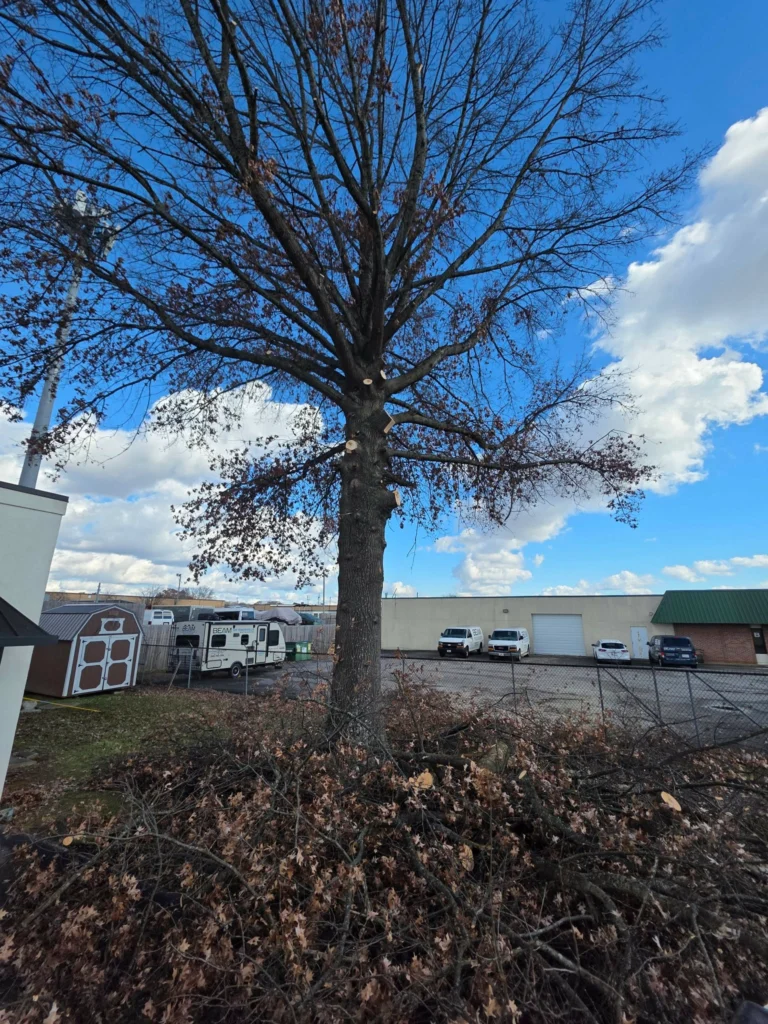
This is usually the first symptom homeowners notice. The very top branches of the tree start to thin out, leaf out late, or fail to leaf out at all. Below those bare top branches, the rest of the canopy might still look fine.
Crown dieback happens because EAB galleries cut off the tree’s ability to move water to the highest, farthest points first. The top of the tree literally starves while the lower limbs hang on a little longer.
If you see one ash tree in the area with a thinning top, look at every other ash within a quarter mile. EAB does not stay in one tree. Where there is one, there are usually more.
Sign 2: D-Shaped Exit Holes
This is the smoking gun. When adult EAB beetles emerge from a tree in late spring, they chew their way out through the bark, leaving distinctive D-shaped holes about 1/8 inch wide. They look like a capital D pressed flat into the bark.
Round holes mean other beetles, not EAB. Larger holes mean borers, but not necessarily EAB. The D-shape is specific. If you see D-shaped holes in ash bark, the tree is infested. Period.
Sign 3: Woodpecker Damage (Blonding)
Woodpeckers absolutely love EAB larvae. They are basically a free buffet under the bark. As woodpeckers go after the larvae, they strip away the outer bark to expose the lighter wood underneath.
This creates patches of light-colored, almost “sandblasted” looking bark on the trunk and main branches. Arborists call this blonding, and it is often the first thing we notice from the ground when we suspect EAB. If you see blonding on an ash tree, infestation is virtually certain.
Sign 4: Epicormic Sprouts (Stress Shoots)
As an ash tree starts dying from the top down, it tries to compensate by sending out new shoots from the base of the trunk and from healthy lower branches. These are called epicormic sprouts.
They look like a cluster of vertical, leafy stems erupting where you would not normally expect them. The tree is essentially trying to start over from a healthier section. It is a survival response, and it is a clear sign the tree is in trouble.
Sign 5: Vertical Bark Splits
As galleries form under the bark and the tree dies in patches, the bark itself can split vertically. Sometimes you can see the S-shaped galleries underneath right through the split.
Bark splitting on an ash tree, especially combined with any of the other signs, means the infestation is well-established.
Sign 6: S-Shaped Galleries Under the Bark
This is the most conclusive evidence, but it requires getting under the bark to see it. If you peel back a piece of loose bark on a suspected ash, you will find winding, snake-like tunnels packed with fine sawdust-like frass. These galleries are unmistakable. They are EAB’s signature.
Why EAB Is So Hard to Catch Early
This is the cruel reality of EAB management: by the time the tree shows obvious symptoms, you have already lost much of your treatment window.
EAB larvae feed under the bark for a full year before adults emerge and produce visible exit holes. During that first year, the tree often looks completely normal from the outside. By year two, you might see slight crown thinning. By year three, the tree is in obvious decline. By year four, you are usually looking at a removal job.
That timeline is why proactive monitoring matters so much. If you have ash trees, you should be inspecting them every spring. Look for the warning signs before they become impossible to miss. If EAB is in your neighborhood (and in Knoxville, it almost certainly is), assume your trees are at risk and act accordingly.
Step 3: Protecting Healthy Ash Trees with Treatment
Here is the good news in an otherwise grim story: healthy ash trees can be effectively protected from EAB with the right treatment, applied at the right time. The protection is not 100% permanent, but it works, and it works well.
The most effective treatments use systemic insecticides, which are absorbed by the tree and circulated through the same vascular system that EAB larvae feed on. When larvae try to feed, they get a lethal dose of insecticide. The tree survives, the EAB does not.
Trunk Injection (The Gold Standard)
Trunk injection is the most effective EAB treatment available. A trained applicator drills small holes around the base of the tree and injects a precise dose of insecticide directly into the vascular system. The tree carries the chemical up into the canopy on its own.
The most commonly used product for professional trunk injection is Emamectin Benzoate, sold under brand names like Tree-age. A single injection provides about 99% control of EAB and lasts approximately 2 to 3 years before retreatment.
This method works on trees of any size and is the only reliable option for large, mature ash trees that are too valuable to lose. The catch is that it has to be done by a licensed applicator. Homeowners cannot legally buy or apply Emamectin Benzoate.
Soil Drench (DIY Option for Smaller Trees)
For smaller ash trees, typically under 20 inches in diameter at chest height, homeowners can apply a soil drench containing Imidacloprid. This is sold over-the-counter at garden centers and home improvement stores under brand names like Bayer Tree & Shrub Insect Control.
The product is mixed with water and poured around the base of the trunk. The roots absorb the insecticide and carry it throughout the tree. Application timing is critical: in Knoxville, the best window is mid-April through mid-May, when the tree is actively taking up water.
Soil drenches are less effective than trunk injections, especially on larger trees. They also need to be reapplied every year. For small ornamental ash trees in good health, they can work. For mature shade trees, professional injection is the smarter call.
Why Timing Matters So Much
Whether you choose injection or soil drench, the treatment has to be in the tree before EAB larvae start feeding for the year. Apply too late, and you protect against next year’s generation while losing this year’s tree.
In our area, that means applications need to happen in April or early May at the latest. We recommend booking treatment appointments by March if you can, because the spring window is short and books up fast across Knoxville.
Treatment Cost vs. Removal Cost: The Real Numbers
This is the question every homeowner with a sick ash tree has to answer: is it worth treating, or should I just remove it? The math depends on the tree’s size, condition, and how much you value it.
Typical Treatment Costs in Knoxville
- DIY soil drench (small tree): $30 to $80 per year for product. Has to be reapplied annually.
- Professional trunk injection (medium tree, 12 to 18 inch diameter): $150 to $350 per treatment, every 2 to 3 years.
- Professional trunk injection (large tree, 24+ inch diameter): $300 to $700 per treatment, every 2 to 3 years.
Typical Removal Costs in Knoxville
- Small ash tree (under 30 feet): $300 to $800.
- Medium ash tree (30 to 60 feet): $700 to $1,500.
- Large ash tree (60+ feet): $1,500 to $3,000+.
- Dead, brittle ash tree near a structure: Add 30% to 50% for the safety challenges of working with brittle wood.
If you are weighing treatment versus removal on a borderline tree, our tree removal cost guide for Knoxville goes deeper into all the factors that affect pricing, including stump grinding, debris hauling, and access challenges.
| The Treatment Math (Real Example) 20-inch diameter Green Ash, healthy, 50 feet tall, in your front yard.Trunk injection: $250 every 2 years = $125/year average.Eventual removal cost: ~$1,200.Replacement tree (mature transplant): $400 to $800.Total cost to remove and replace: ~$2,000.Treatment math: it takes about 16 years of treatment to equal the cost of removing and replacing.If the tree is healthy and worth keeping, treatment is usually the better economic decision. |
Step 4: When Removal Is the Only Smart Choice
Not every ash tree can or should be saved. If the infestation has progressed too far, treatment becomes both more expensive and less effective. At a certain point, you are throwing good money after bad.
Here are the situations where we tell homeowners to skip treatment and go straight to removal.
More Than 30% to 50% Canopy Loss
Once a tree has lost more than 30% of its canopy to EAB damage, treatment success rates drop sharply. Beyond 50% loss, treatment is generally not worth attempting. The tree’s vascular system is already too compromised to distribute insecticide effectively, and even if you kill the EAB, the tree may not recover.
Significant Bark Splitting or Vertical Cracks
Major structural damage to the trunk means the tree is in advanced decline. The wood is already weakening. Even if you stopped EAB tomorrow, the tree’s days are numbered.
Hazardous Location
A declining ash tree close to your house, garage, driveway, or power lines is a different calculation. Even a tree that might be saved with treatment becomes a liability if it could fall on something important. In those cases, removal is often the safer call.
The Tree Is Already Dead
This sounds obvious, but homeowners sometimes ask if a dead ash can be brought back. It cannot. Once the tree is dead, the only question is how quickly it can be removed safely. Dead ash trees deteriorate very fast. If you have a confirmed dead ash on your property, getting it on the schedule for tree removal should happen within weeks, not months.
Why Dead Ash Trees Are More Dangerous Than Most People Realize
This is the single most important thing for ash tree owners to understand: dead ash is not like dead oak.
When most hardwoods die, the wood stays sound and stable for years. Dead oaks can stand for a decade. Dead maples often hold up for several years. You have time.
Dead ash is different. The wood goes brittle within months of death, sometimes within weeks. The branches snap with very little provocation. The trunk itself can shatter unexpectedly. We have had crew members tell us about dead ash trunks that fell apart while being roped, dropping huge chunks of wood in unpredictable directions.
From a removal standpoint, this changes everything:
- Climbing a dead ash is far more dangerous than climbing a healthy tree. Many companies will not climb them at all and instead use cranes or bucket trucks, which adds cost.
- Branches that look solid can snap off without warning when touched.
- Storm-damaged dead ash trees often fall in unpredictable directions because the wood does not behave like normal wood.
- The longer a dead ash stands, the more dangerous and expensive it becomes to remove.
If you have a dead ash near your house and a storm is forecasted, we treat it as an urgent situation. Emergency tree service in Knoxville exists exactly for these high-stakes cases where waiting is not an option.
What to Do with the Wood: Firewood Rules in Tennessee
State and federal EAB quarantines were officially lifted in 2021, but the Tennessee Department of Agriculture still strongly discourages moving ash firewood. The reason is simple: hauling infested wood is one of the main ways EAB spreads to new areas.
If you have an ash tree removed, the rule is to keep the wood local. Specifically:
- Keep the wood on your property if you can, or have it chipped on site.
- If you burn the wood for firewood, burn it within the same county where it was cut.
- Do not haul ash firewood to a cabin in Sevierville, a campsite in Cherokee National Forest, or anywhere else outside your immediate area.
- Do not give or sell ash firewood to people who plan to move it.
The motto used by state forestry agencies sums it up: “Buy it where you burn it.” The same applies to ash you remove from your own property. Keep it where you cut it.
Replacing Your Ash Tree: Smart Choices for East TN
Losing an ash tree, especially a mature one, leaves a real hole in a landscape. The good news is there are excellent native and well-adapted alternatives that grow well in Knoxville and are not vulnerable to EAB.
Best Replacement Choices for Knoxville
- White Oak (Quercus alba): The classic East Tennessee shade tree. Slow-growing but worth the wait.
- Red Oak (Quercus rubra): Faster-growing than White Oak, with great fall color.
- Tulip Poplar (Liriodendron tulipifera): Tennessee’s other state tree, fast-growing, and resilient.
- American Hornbeam (Carpinus caroliniana): A smaller native tree that’s perfect for medium-sized yards.
- Yellowwood (Cladrastis kentukea): Native, fragrant white blooms in spring, no major pest issues.
- Bald Cypress (Taxodium distichum): Native and surprisingly tolerant of urban conditions.
Avoid Bradford pears, ash, Norway maples, and silver maples. The first three are problem species in our area, and silver maples are too brittle for long-term reliability.
Frequently Asked Questions About EAB
How fast does EAB kill an ash tree?
In healthy trees, 2 to 4 years from initial infestation to death. In stressed trees, sometimes 18 months. Once you see significant canopy thinning, you usually have 1 to 2 years left at most.
Can I treat my ash tree myself?
For trees under 20 inches in diameter, yes. Use an over-the-counter Imidacloprid soil drench applied in April or early May. For larger or more valuable trees, professional trunk injection is far more effective and worth the cost.
How much does EAB treatment cost in Knoxville?
Professional trunk injection runs $150 to $700 depending on tree size, applied every 2 to 3 years. DIY soil drench runs $30 to $80 per year. Compared to a $1,500 removal plus replacement costs, treatment is usually cheaper for trees worth saving.
Are all ash trees in Knoxville already infested?
Not yet, but the pressure is intense. Any untreated ash tree in Knox, Loudon, or Blount County should be considered at high risk. We recommend treating healthy ash trees preventively rather than waiting for symptoms to appear.
Can I burn ash wood in my fireplace?
Yes, ash makes excellent firewood. Just keep the wood local. Burn it on the property where it was cut, or within the same county. Do not transport ash firewood to other regions.
How do I know if treatment is working?
In healthy trees, you should see no canopy decline after treatment. In trees with mild damage already, you may see partial recovery over 2 to 3 years. New leaf growth on previously bare branches is a good sign. Continued decline despite treatment usually means the infestation was too advanced when treatment started.
Will EAB jump to other tree species?
No. EAB only attacks true ash trees in the genus Fraxinus. It cannot harm oaks, maples, hickories, or any other species. So far. Mountain Ash (Sorbus) is technically a different genus and is not affected.
Should I remove a healthy ash tree just because of EAB risk?
No. Healthy ash trees can be effectively protected with treatment for many years. Preemptive removal of a healthy tree is unnecessary and wasteful. Have a qualified arborist evaluate your specific tree before making any decision.
What other tree diseases should I watch for in Knoxville?
Plenty. East Tennessee deals with everything from oak wilt to Dutch elm disease to bacterial leaf scorch. Our upcoming guide on common tree diseases in Tennessee covers what to look for and how to manage each one. EAB is the biggest threat right now, but it is not the only one.
Your EAB Decision Roadmap
Putting it all together, here is the decision tree we walk homeowners through every spring:
- Step 1: Confirm the tree is an ash. Opposite branching, compound leaves, diamond-patterned bark.
- Step 2: Inspect for warning signs. Crown thinning, D-shaped holes, blonding, sprouts, bark splits.
- Step 3: Assess canopy loss. Less than 30%? Treatment is a strong option. More than 50%? Plan for removal.
- Step 4: Choose your method. Professional injection for mature trees, DIY soil drench for smaller ones, removal for the worst cases.
- Step 5: Act in spring. Treatment must happen by mid-May to protect against this year’s generation.
- Step 6: Plan for replacement. If a tree is coming down, decide now what is going in its place.
The most important thing is to act, not wait. Every year homeowners call us about ash trees they meant to deal with last spring, and now those trees are in much worse shape. EAB does not slow down because you are busy.
If you have ash trees on your property and you want a clear answer on what to do with them, our team handles EAB inspections across our service areas in Knoxville, Knox County, Lenoir City, Loudon County, Maryville, and Blount County. We will tell you exactly what we see and give you straight advice on whether to treat, monitor, or remove.
Reach out at (423) 519-7484 or schedule online. The earlier we look, the more options you have.