What to Do After a Storm Damages Your Trees in Knoxville (Emergency Guide)
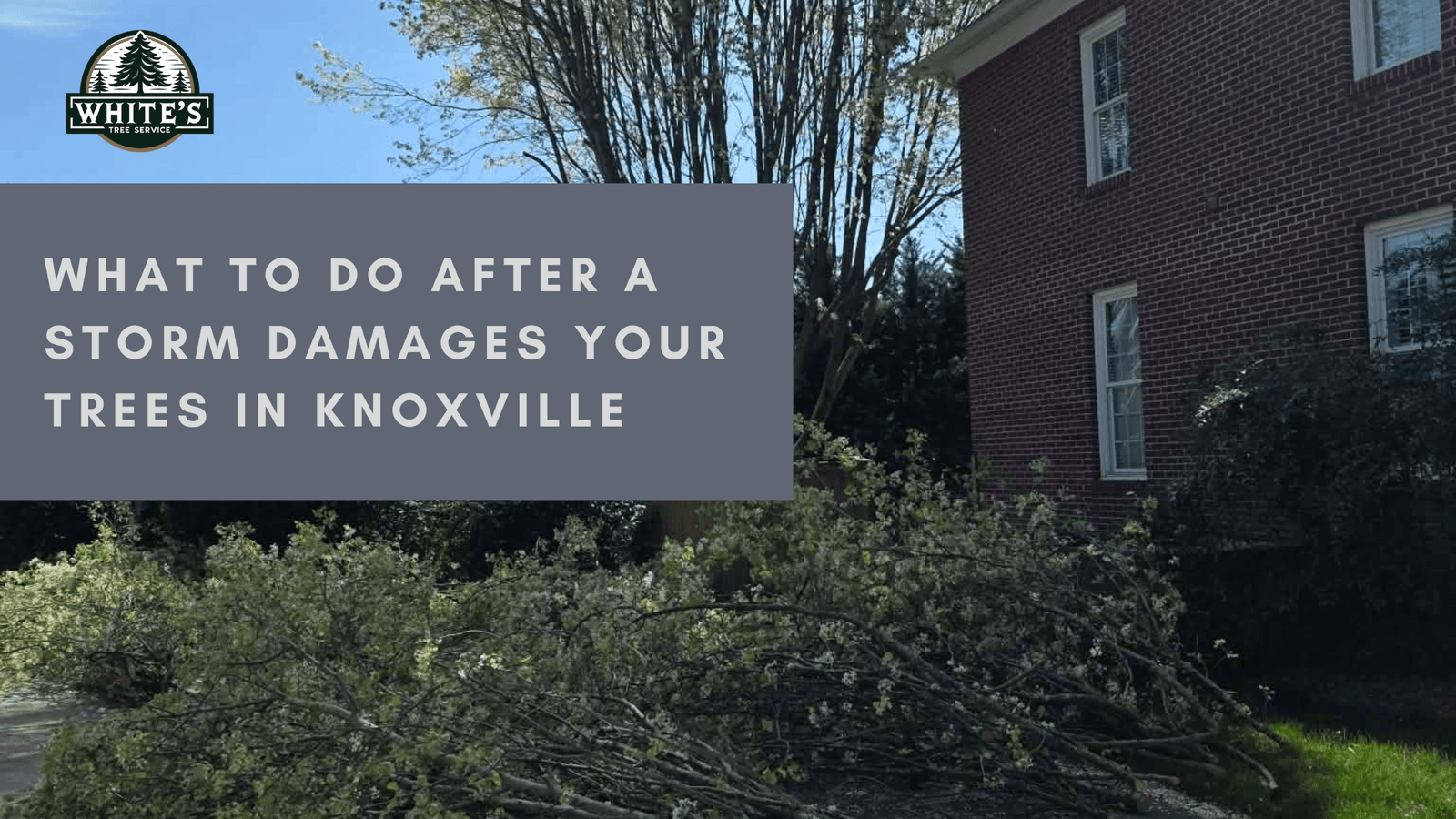
It is two in the morning, the wind is howling, and you hear a sound you will remember for the rest of your life. A snap, a creak, then a crash that shakes the entire house. You grab a flashlight, look out the window, and see your worst fear: a tree on your roof, a fence flattened, branches everywhere.
If you are reading this in the middle of dealing with storm damage to trees in Knoxville right now, take a breath. We are going to walk through this step by step, in the right order, so you do not make the situation worse.
Our crew at Whites Tree Services responds to storm calls across Knox, Loudon, and Blount counties year-round. We have helped hundreds of Knoxville families through exactly what you might be facing right now. Some of the calls come at noon, some at midnight. They all share the same pattern: people in shock, trying to figure out what to do first.
This guide is the answer to that question. Read what applies to your situation, skip the rest, and when in doubt, call us. We are not going anywhere.
First, Take a Breath: Why the Next 60 Minutes Matter Most
The biggest mistakes people make after a storm happen in the first hour. They are running on adrenaline, they want to fix things now, and they make decisions that get them hurt or get their insurance claim denied.
Here is the reality: unless someone is injured or actively trapped, almost nothing about your situation requires action in the next 60 minutes. The tree on your roof is not going to fall through any harder. The branches on your fence are not going to multiply. Slowing down and following the right sequence will save you money, prevent injury, and result in a faster, smoother recovery.
| The Three Rules of Storm Aftermath Rule 1: Safety always comes before property. Property can be replaced. You cannot. Rule 2: Document before you touch. Photos and video taken before cleanup are worth their weight in gold for insurance. Rule 3: When in doubt, wait for daylight and a professional. Most storm damage looks worse than it is, and rushing creates more problems than it solves. |
Phase 1: The Golden Hour of Safety
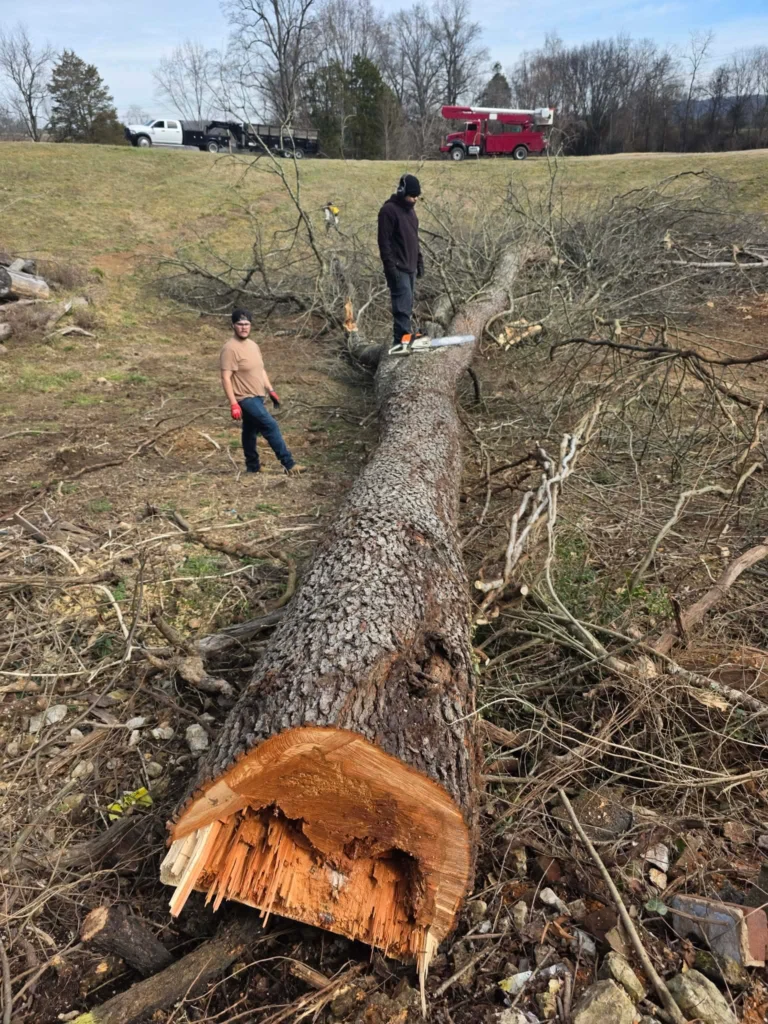
Before you touch a single twig, clear the area of invisible hazards. Storm-damaged trees are under enormous tension and are far more dangerous than they look. We cannot say this loud enough.
Power Lines: The 30-Foot Rule
If a tree or branch has fallen on a power line, or even close to one, stay at least 30 feet away. Treat every downed wire as if it is live, because it might be. Even when the power appears to be out, lines can re-energize at any moment as the grid is restored.
Saturated ground in Knoxville’s clay soil makes this worse. Roots torn out of wet earth can pull lines tight or snap them under fallen branches where you cannot see the damage. The line might be hidden under foliage, sparking quietly, ready to electrocute the first person who steps on it.
Call KUB (Knoxville Utilities Board) at (865) 524-2911 to report any downed lines. KUB has crews on call 24/7 for exactly this situation. Wait for them to clear the lines before any tree work starts. No exceptions.
Look Up Before You Look Down
The hidden killer after most storms is something arborists call a “widowmaker.” That is a large branch that has snapped but is still hanging in the canopy, balanced on other branches. They can stay up there for hours or days, then fall without warning.
Walk under your trees with your eyes up. Anything you see hanging that should not be there gets a 25-foot wide circle around it that nobody enters until a pro takes it down. Mark the area with rope, cones, or tape if you have them. If kids or pets are around, lock them inside until the area is secured.
Leaning Trees and Failed Roots
If a tree is leaning at a new angle, or you see soil heaving up around the base, the root plate has failed and the tree is in the process of falling. It might take it five more minutes or five more days, but gravity is winning.
Stay back at least 1.5 times the height of the tree. So a 60-foot tree means a 90-foot exclusion zone. Get everyone clear, then call for professional removal. Do not, under any circumstance, try to push, pull, or climb it.
Call 911 If…
Some situations are real emergencies and need first responders, not a tree service:
- Anyone is injured or trapped.
- A tree has crashed through your home with people inside.
- You smell gas (downed trees can rupture gas lines).
- There is fire from sparks or downed lines.
- A tree is blocking the only road in or out of your neighborhood.
Phase 2: Assess the Damage from a Safe Distance
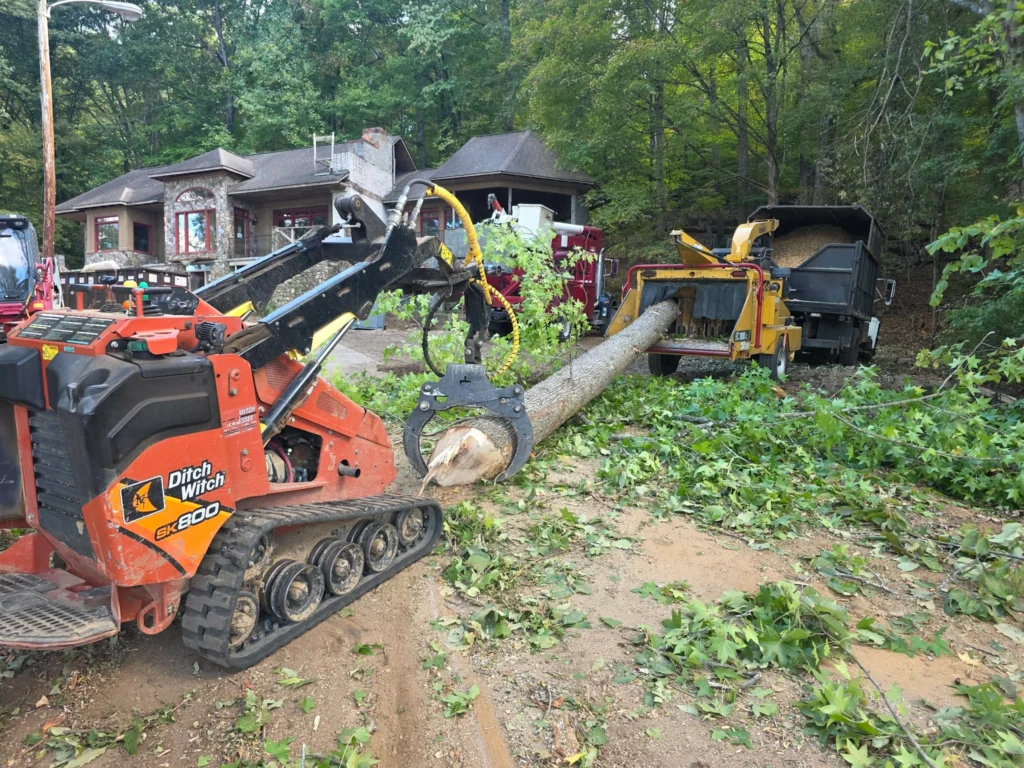
Once you have ruled out immediate hazards and any injured people are taken care of, do a careful walk-around of your property from a safe distance. Use binoculars if you have them. Stay out of any high-risk zones.
Note what you see, in detail. You will want this information for both the tree service and your insurance company.
Types of Damage to Categorize
- Trees on structures: Anything resting on your roof, garage, deck, fence, or vehicle. These are top priority and require professional response.
- Hanging widowmakers: Broken branches still hung up in the canopy. Dangerous, even if they are not on anything yet.
- Split or cracked trunks: Vertical splits, missing chunks, or branches torn off with bark stripped down the main trunk. Often means full removal.
- Uprooted or leaning trees: Soil lifted, root plate exposed. Almost always require removal in saturated Knoxville soil.
- Branches on the ground: The least urgent category, but still needs cleanup before grass mowing season starts.
- Shredded leaves and small twig debris: Mostly cosmetic. Will rake up easily once everything else is handled.
How Bad Is It, Really?
Some storm damage looks catastrophic but is actually fixable. Other damage looks minor but is hiding a structural problem that will fail in the next storm. A few signs that point in each direction:
Probably Fixable
- Lost some smaller branches and twigs, but main structure is intact.
- A few medium branches snapped off, but tree retains over 50% of canopy.
- Bark damage that does not extend deep into the wood.
- Tree was healthy before the storm and is still standing upright.
Probably Has to Come Down
- More than 50% canopy loss.
- Trunk cracked or split open.
- Tree leaning at a new angle, with visible root plate failure.
- Major branches torn off, leaving deep wounds in the trunk.
- Tree is hung up on another tree or a structure.
Final calls on whether a tree can be saved should come from a trained arborist, not from looking at it from your kitchen window. But this gives you a starting point for the conversation.
Phase 3: Document Everything for Insurance
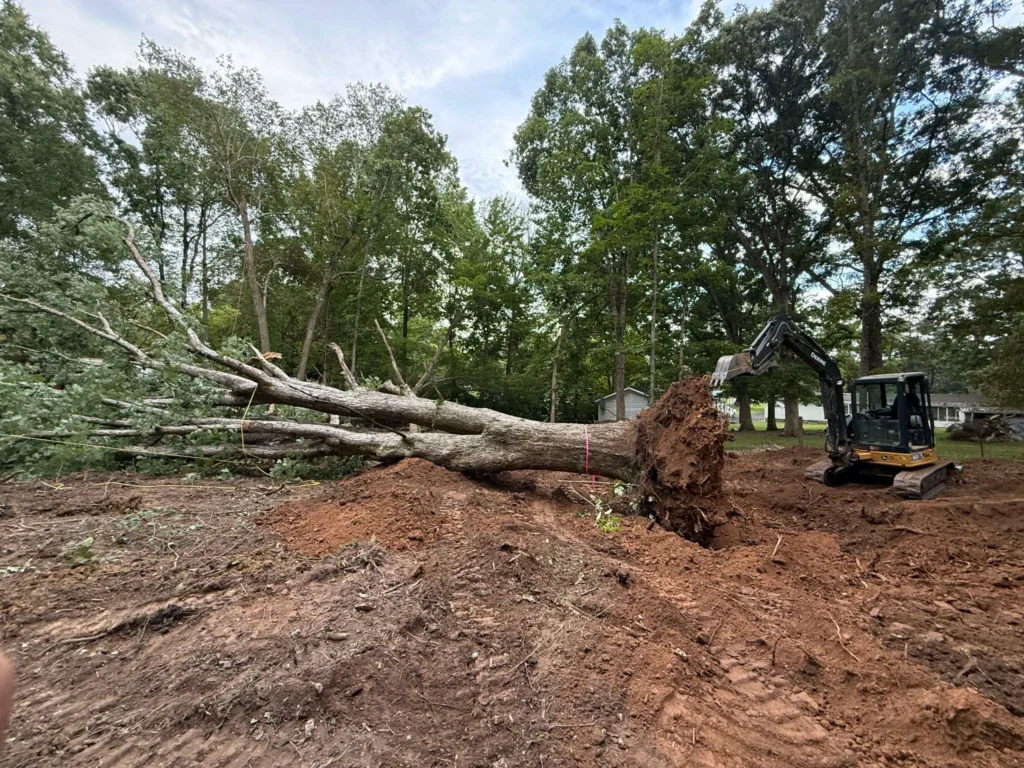
This is the step almost everybody rushes past, and it costs them money. Before any cleanup, before you touch a single branch, document the scene. Your insurance payout often depends on the quality of your photos.
What to Photograph
- Wide shots showing the relationship between the tree and the damaged structure (the angle of impact tells the story).
- Close-ups of all damage to your house: shingles, gutters, siding, windows, and any interior damage if water got in.
- Photos of the tree itself, including the broken trunk, root system, and any visible disease or decay (or lack of it).
- Photos of damage to vehicles, fences, sheds, decks, and outbuildings.
- Photos of any debris on the ground that came off the tree.
- Wide shots of your yard from multiple angles for context.
Take Video Too
A 60-second video walking around the damage zone, narrating what you see, is incredibly valuable. “Here is the tree, you can see it came down on the southwest corner of the house. Here is the damage to the gutters. Here are the shingles missing from the roof.” Adjusters love this. It tells the whole story in one clip.
What Insurance Actually Covers
This is one of the most misunderstood parts of storm damage. Most homeowners assume their insurance covers all tree-related cleanup. It usually does not.
Standard homeowners insurance typically covers tree removal in these situations:
- The tree hit a covered structure (house, garage, attached fence).
- The tree blocks access to your property (driveway or main entrance).
- The tree is on a vehicle (covered under your auto comprehensive policy, not homeowners).
Insurance typically does NOT cover:
- Trees that fell in your yard but did not hit anything.
- Removal of healthy trees you decide to take down preemptively.
- Tree damage that is determined to result from neglected maintenance.
That last one is why documenting the tree’s condition before storms hit matters so much. If your tree care had been kept up to date, you have a much stronger case that the failure was an act of nature, not neglect. Annual inspections create a paper trail that supports your claims.
If you want to know what tree removal typically costs in our area (with or without insurance), our tree removal pricing guide breaks it down by tree size, complexity, and whether emergency response is required.
Phase 4: Know What Counts as a Real Emergency

Not all storm damage is an emergency. Knowing the difference helps you respond appropriately and avoid paying emergency rates for a non-emergency situation.
True Emergency (Call Right Now)
- A tree has fallen on your house, garage, or other occupied structure.
- A tree is leaning on your house but has not yet fallen.
- Large limbs are hanging directly over an entrance, driveway, or area where people gather.
- A tree is blocking your only access route in or out of the property.
- Tree damage has compromised your home’s roof or wall integrity.
- Trees have fallen on or are entangled with power lines (call KUB first, then us).
Same-Day or Next-Day
- Trees down in your yard but not on structures.
- Damaged trees that are still standing but clearly not stable.
- Hanging branches over secondary structures like sheds or fences.
Can Wait a Few Days
- Branches and debris on the ground.
- Cosmetic damage to trees that are not structurally compromised.
- Cleanup of leaves, twigs, and shredded foliage.
For the genuine emergencies, our 24/7 emergency tree services team responds at any hour. The difference between calling at midnight versus waiting until morning can be the difference between containing the damage and watching it spread.
Phase 5: Why You Should Never DIY Major Storm Damage
We get it. You watch some YouTube videos, you have a chainsaw in the garage, and the tree is right there. How hard can it be?
Storm-damaged trees are not normal trees. They are physics problems with bark on. Every year in the United States, dozens of homeowners are killed and hundreds more seriously injured trying to deal with storm damage themselves.
Why Storm Trees Are So Different
A healthy tree being cut down behaves predictably. The cuts go where you make them. The tree falls in the direction you plan. The forces involved are large but understandable.
A storm-damaged tree is a different animal entirely. Branches under tension can snap back violently when cut, with enough force to break ribs or worse. Trees that look stable can shift suddenly when weight is removed. Compromised wood does not behave like sound wood, especially with brittle species like ash or storm-shocked pines. A cut that should have made the tree fall north might cause it to twist and fall east, right onto your house.
The Specific Things That Will Hurt or Kill You
- Spring poles: Branches bent under tension by the weight of the tree. Cut them wrong and they fly back at chainsaw speed.
- Hung-up trees: Trees that have fallen but are caught in another tree. Released improperly, they can pivot and crush whatever is below.
- Shifting weight: Removing one branch changes the balance of the entire tree. Predictability disappears fast.
- Hidden damage: Internal cracks you cannot see from the outside. The trunk looks solid, then it shatters mid-cut.
- Chainsaw kickback: Even experienced sawyers get hurt by kickback. Storm wood, with all its weird angles and tension, makes kickback more likely.
Hiring a licensed crew for professional tree removal in Knoxville is not just about doing the work right. It is about not becoming a statistic. The cost of a pro is far less than the cost of an emergency room visit, surgery, rehab, or worse.
Phase 6: Handle Small Debris Safely (What You CAN Do)

There is plenty of cleanup work that homeowners can safely handle themselves. Here is the line between DIY-friendly and call-a-pro.
Safe to DIY
- Small branches under 4 inches in diameter that are fully on the ground.
- Loose leaves, twigs, and shredded foliage.
- Light raking and bagging of yard debris.
- Sorting branches into piles for chipper pickup or burning (where allowed).
Pro Equipment Required
- Anything tangled with larger branches above it.
- Branches under tension or supporting other debris.
- Trunks larger than 6 inches in diameter.
- Anything requiring a ladder or chainsaw above shoulder height.
- Trees still standing but visibly damaged or unstable.
DIY Safety Basics
If you are doing the small stuff yourself, do it right:
- Wear closed-toe shoes (work boots are better), long pants, and work gloves.
- Eye protection is a must. Twigs and bark fragments fly more than you would think.
- Keep your phone in your pocket. Working alone? Tell someone where you are and when to expect a check-in.
- Do not work in fading light. Save the cleanup for daylight hours.
- Pace yourself. Adrenaline runs out fast and tired people make mistakes.
Phase 7: Tarp the Roof and Prevent More Damage
If a tree damaged your roof and rain is in the forecast, you need to tarp it as soon as possible to prevent water damage from making the situation worse. But this needs to be done safely.
When You Should NOT Tarp Yourself
- If the tree is still on the roof or in contact with the roof structure.
- If the roof appears to be sagging or compromised.
- If the pitch of your roof is steep (over 6/12 pitch is risky for amateurs).
- If it is wet, dark, or windy.
- If you are alone with no spotter.
If You Can Do It Safely
If the tree is gone, the roof is structurally fine, the pitch is mild, and you have help, you can place a temporary tarp. Use a tarp at least 6 feet larger than the damaged area on each side. Run the top edge over the ridgeline of the roof. Secure the edges with 2×4 boards screwed into the underlying roof structure. Tape and staples will not hold in any real wind.
Most insurance companies will reimburse you for reasonable temporary repairs that prevent further damage. Save your receipts.
Phase 8: Call a Local Tree Service Right Away
After major storms, every reputable tree service in Knoxville gets slammed with calls. Within the first 24 hours after a serious weather event, most companies are booked solid for days.
The homeowners who get fastest service are the ones who call first. Even if your situation is not the most urgent, getting on the schedule early matters. Waiting a few days means competing with everyone who got hit.
Who to Call (and Who to Avoid)
Call licensed, insured, local companies you can verify. Look for these specific things:
- A physical local address, not just a phone number.
- Proof of liability insurance (ask for a certificate).
- Workers’ compensation coverage.
- Local business license.
- Reviews from real Knoxville-area customers.
- ISA certification on staff or willingness to bring one in.
Our tree service in Knoxville team has been local since 2014, fully licensed and insured, and we keep emergency response slots open during storm season specifically for situations like yours. Call us at (423) 519-7484 any time of day or night.
Phase 9: Evaluating Trees That Survived the Storm
After the immediate hazards are dealt with, you need to look at the trees that are still standing and figure out which ones are okay and which ones are silently damaged.
Some trees that look perfectly fine right after a storm fail weeks or months later because of internal damage that was not obvious. The 50% rule is a good starting point: if a tree has lost more than half of its living canopy, its long-term survival is doubtful and proactive removal often makes more sense than hoping for recovery.
Signs of Hidden Storm Damage
- Trunk cracks that were not there before, even if they look small.
- Bark damage that goes deep into the wood, exposing the lighter inner layers.
- Branches with bark stripped along their length, often pointing toward an injury at the trunk.
- Unusual sounds (creaking, popping) from the tree on calm days.
- New leaning or visible movement of the tree at the base.
- Sap weeping from places it was not before.
Wound Care for Surviving Trees
If branches were torn off and left ragged stumps, those will not heal well. A clean cut at the branch collar (the slightly swollen ring where the branch meets the trunk) lets the tree seal the wound naturally.
Do not paint, seal, or wrap wounds. Decades of research has shown this actually slows healing and traps moisture, encouraging rot. Trees evolved to seal their own wounds. Help them by making clean cuts and otherwise leaving the wounds alone.
Phase 10: Reclaiming Your Property and the Cleanup Phase
Once the major hazards are addressed, you are still going to be staring at a yard full of debris. Here is how to handle the rest efficiently.
Sort Debris into Categories
- Small brush and leaves: Knoxville offers seasonal brush pickup. Check the Knox County Solid Waste website for current schedule.
- Larger branches and limbs: These typically need professional chipping or hauling.
- Hardwood logs: Save them for firewood if you have a fireplace, or have them cut to length and hauled.
- Stumps: Should be ground below grade to prevent decay, pest harborage, and tripping hazards.
Brush Clearing Service
If your storm cleanup leaves you with a yard full of brush and limbs, our brush clearing service can handle the whole job in one visit. Faster than waiting for city pickup, especially after big storms when pickup schedules get backed up.
Don’t Forget the Gutters
Storm debris always ends up in gutters and downspouts. Within a week of any major storm, climb up safely and clear them out. Clogged gutters dump water against your foundation during the next rain, which leads to a whole new set of problems.
Inspect for Hidden Damage
Walk your property at least once a week for the next month. Look for new symptoms on stressed trees: late leaf-out, dieback at branch tips, unusual fungus growth at the base, or further leaning. Storm damage continues to reveal itself for weeks or months after the actual event.
Beware of Storm Chasers and Out-of-State Scammers
Within hours of any major storm in East Tennessee, out-of-state operators show up in Knoxville with chainsaws and pickup trucks, going door to door offering cheap removal. They are sometimes called “storm chasers,” and they cause real problems for homeowners every year.
How to spot them and what to do:
Red Flags
- Cash-only payment, especially up front.
- No physical local address. They give you a phone number and that is it.
- Pressure to sign a contract immediately.
- Refusal to provide proof of insurance or licensing.
- Out-of-state license plates on the truck.
- Prices that are way below local average (the work won’t be done right, or won’t be done at all).
How to Protect Yourself
- Get at least three written estimates before signing anything.
- Verify insurance with the insurance company directly, not just by looking at a paper certificate.
- Check Google reviews and the Better Business Bureau.
- Never pay in full upfront. Reasonable deposits (10 to 25%) are normal; full payment before work is not.
- If something feels off, walk away. There will be other companies.
Emergency Contact Cheat Sheet for Knoxville
| Save These Numbers Life-Threatening Emergency: 911 Knoxville Utilities Board (KUB) for Downed Lines: (865) 524-2911 Knoxville City Services / Trees Blocking Public Roads: 311 Knox County Sheriff (non-emergency): (865) 215-2243 Whites Tree Services (24/7 Emergency Response): (423) 519-7484 Tennessee Emergency Management Agency: 1-800-262-3300 Knox County Solid Waste (brush pickup info): (865) 215-6700 |
Insurance Tips That Actually Work
Filing a homeowners insurance claim after storm damage is a process that rewards organization and punishes guesswork. Here is what we have learned from helping hundreds of Knoxville homeowners through it.
Call Your Insurance Company First
Before signing anything with a tree service or contractor, call your insurance company and report the damage. Get a claim number. Ask what their procedure is for emergency mitigation work versus full repair work. Some policies require pre-approval for major work.
Save Every Receipt
Anything you spend related to the damage is potentially reimbursable: tarp materials, emergency tree work, a hotel if you cannot stay in your house, even gas mileage to and from temporary lodging. Keep every receipt and a log of expenses.
Don’t Repair Before the Adjuster Sees It
Most policies require that you allow the adjuster to inspect the damage before significant repairs begin. The exception is emergency mitigation work that prevents further damage, like tarping a roof or removing a tree that is actively crushing something. Take photos before, during, and after any emergency work, and keep receipts.
Get the Tree Service to Itemize
Make sure your tree service provides an itemized invoice that breaks out emergency response, removal, cleanup, stump grinding, and any other line items separately. This makes the claim process much easier and helps your adjuster understand what was actually done.
Frequently Asked Questions
How fast can you get out here after a storm?
During major storm events, our crew prioritizes calls based on safety. True emergencies (trees on houses, blocked entrances, downed lines) get same-day response, often within hours. Non-urgent situations may be scheduled within 24 to 72 hours depending on call volume.
How much does emergency tree removal cost in Knoxville?
Emergency response carries a premium of about 30 to 50% over standard pricing because of after-hours scheduling, urgency, and the complexity of working with damaged trees. Typical emergency removal runs $800 to $5,000 depending on size, complexity, and access.
Will my insurance cover emergency tree removal?
Usually yes, if the tree fell on your house, garage, or other covered structure. Standard homeowners insurance covers removal of the tree from the structure plus repair of the damage. They typically do not cover removal of trees that fell in your yard but did not hit anything.
What if my neighbor’s tree fell on my house?
Almost always, your own homeowners insurance covers the damage and removal, regardless of whose tree it was. Insurance companies sometimes pursue subrogation against the neighbor’s insurance if the tree was clearly diseased or neglected, but this is between the insurance companies and does not affect your claim process.
Can I save a tree that lost a major branch?
Sometimes. If the tree retains over 50% of its canopy, has no major trunk damage, and the wound can be cleaned up with proper pruning, recovery is possible over several years. A professional arborist assessment will give you a clear answer.
How long do I have to file an insurance claim?
Most policies require notification within 30 days, with full claim filing typically required within 60 to 90 days. Sooner is always better. Some policies have shorter deadlines for emergency mitigation expenses.
Is it safe to stay in my house if a tree hit it?
That depends on the damage. If the tree compromised the roof structure, walls, or any load-bearing elements, evacuate until a structural assessment is done. If the damage is limited to siding, gutters, or shingles, you can usually stay, but get a tarp up before the next rain.
How to Prepare for the Next Storm
The best time to prepare for storm damage is before any storm is in the forecast. Once your current situation is resolved, take some time to make sure the next event hits you a lot less hard.
Annual tree maintenance is the single biggest factor in how much storm damage you take. Following a complete spring tree care checklist every year dramatically reduces your risk. The trees we trim regularly almost never fail in storms. The trees that nobody has touched in 10 years are the ones that drop limbs through roofs.
Other smart preparation steps:
- Keep a document file with photos of every side of your house, taken on a clear day. These prove pre-storm condition for insurance.
- Maintain a list of emergency contacts somewhere easy to find.
- Know where your insurance documents are (digital copies in cloud storage are gold).
- Schedule a professional tree assessment every spring, especially for any tree that could hit your house.
- Address known problem trees before they become emergencies.
If you want help getting your property storm-ready before next spring, our team handles assessments, preventive trimming, and proactive removals across Knoxville and the surrounding counties. Schedule a free estimate at (423) 519-7484, and we will walk your property with you to identify anything that needs attention.
Storms are part of life in East Tennessee. The damage they cause does not have to be.