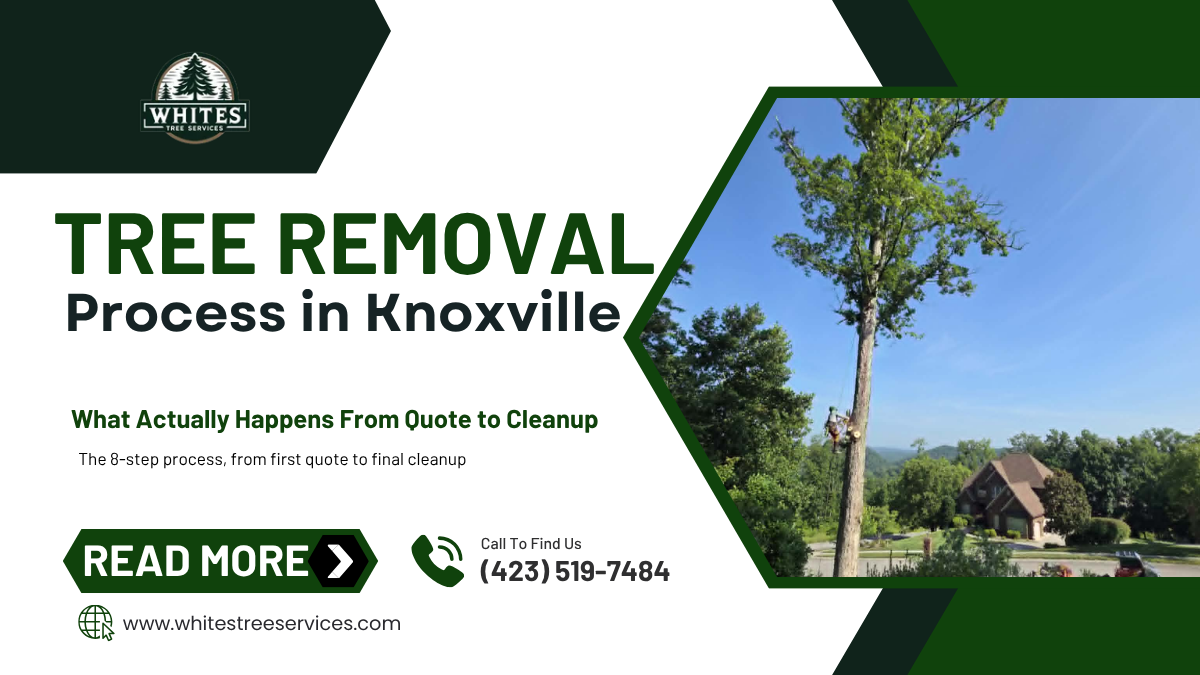
Tree Removal Process in Knoxville: What Actually Happens From Quote to Cleanup
Every Knoxville homeowner facing a tree removal has the same question: what is actually going to happen in my yard? How long will it take? Who’s responsible for the mess? Do I need to be home? Will the crew tear up my lawn getting to the tree? What about my sprinklers, my fence, my neighbor’s shed?
The honest answer is that tree removal in Knoxville TN is a lot more organized than it looks from the street. A professional tree removal crew follows a repeatable eight-step process from the first phone call to the final cleanup, and once you understand what happens at each stage, most of the anxiety around the job goes away.
This guide walks through the entire tree removal process as it actually happens on residential properties across Knox County, Loudon County, and Blount County. Whether you’re planning ahead for a dead ash tree that has to come down before winter or trying to figure out what to expect after a storm dropped a limb on your roof, you’ll leave this page knowing exactly what a real tree removal in Knoxville looks like from start to finish.
The Full Tree Removal Process in 8 Steps
Here’s the complete tree removal process from first contact to cleanup. Each step is covered in detail below, but this quick overview gives you the shape of what to expect.
- Free on-site estimate and tree assessment: An estimator visits the property, evaluates the tree, plans the removal method, and provides a written quote.
- Permits, KUB, and 811 coordination: If the job needs any permits, utility notifications, or line-clearance work, this happens before scheduling.
- Scheduling and homeowner prep: The job is scheduled and the homeowner is told what to move, contain, or protect before the crew arrives.
- Site setup and safety zones: The crew arrives, walks the job, marks drop zones, lays down protection mats, and sets up equipment.
- The actual removal: The tree comes down using felling, sectional dismantling, bucket truck, or crane depending on size and location.
- Chipping, log handling, and debris removal: Brush is chipped, trunk sections are cut into manageable logs, and everything is hauled away or staged per the agreement.
- Stump grinding (optional add-on): If included in the scope, the stump is ground below grade the same day or on a follow-up visit.
- Final cleanup and site walkthrough: The crew rakes, blows, and inspects the work area, then walks it with the homeowner before leaving.
The whole thing can take anywhere from an hour to two full days depending on the tree and the site. Now here’s what happens at each step in real detail.
Step 1: The Free On-Site Estimate and Tree Assessment
Everything starts with an estimator or lead climber physically standing next to the tree. Any tree service willing to give you a firm price for a residential removal over the phone, from a photo, or from a satellite view is not giving you a real quote. The variables that determine price and safety only become clear on site.
What the Estimator Is Really Looking For
A good estimator walks the property before quoting. Here’s what they’re actually assessing:
- Tree size and species: Height, trunk diameter, crown spread, and wood density all affect how long the job takes and how much debris it produces. A 60-foot tulip poplar and a 60-foot white oak are very different jobs.
- Structural condition: Lean, visible decay, cavity rot at the base, dead limbs, cracks in major branches, and root plate stability. A structurally compromised tree has to be dismantled more carefully than a healthy one.
- Targets below the tree: Your house, garage, deck, pool, fence, driveway, HVAC unit, sprinkler heads, septic lines, and your neighbor’s property. Anything the tree could damage on the way down.
- Drop zone availability: How much clear open space is available for felling or sectioning. Open yards allow simpler methods. Tight urban lots require rigging.
- Utility proximity: Overhead power lines, service drops, transformer boxes, and underground utility lines. Anything within roughly ten feet of a primary line requires KUB coordination.
- Equipment access: Can a chipper truck park in the driveway or on the street? Can a bucket truck reach the tree? Is the gate wide enough? Will the crew need to hand-carry brush from the backyard to the curb? A steep or muddy yard can force smaller equipment.
- Cleanup logistics: Where the debris pile will stage, where chipped material can go, and how logs will be moved off the property.
What Should Be in Your Written Scope
A real tree removal Knoxville TN estimate is a written document, not a verbal number shouted from the truck window. It should identify:
- The specific tree or trees being removed, with location described
- Whether the price includes removal to ground level, and whether stump grinding is included or a separate line item
- Who handles brush, logs, and chips (all hauled away, partially left, chips left as mulch)
- Whether firewood will be cut to a specific length and staged, or hauled
- Any traffic control, utility coordination, or permit work included in the price
- Ground protection provisions for lawns, driveways, or septic areas
- Total price, payment schedule, and how change orders would be handled
For trees where health or hazard is in question and removal is not obviously the right answer, a formal tree assessment may be worth requesting before authorizing the removal. Sometimes the answer is pruning or cabling rather than taking the tree down.
Step 2: Permits, KUB, and 811 Coordination
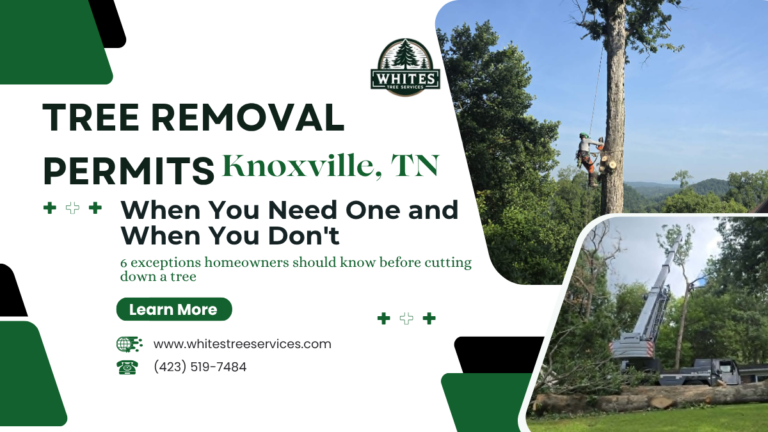
Most private residential tree removal in Knoxville does not require a permit. The City of Knoxville Tree Protection Ordinance specifically exempts single-family and two-family dwellings, so a tree in your own yard can typically come down without any city paperwork.
That said, three situations before removal do require coordination:
Trees in the public right-of-way. The strip of grass between the sidewalk and the street is almost always public property in Knoxville, and any tree growing there belongs to the City. Removing or heavily pruning a right-of-way tree requires approval from Urban Forestry. If you’re not sure where your property line ends, the estimator should check before quoting.
Trees near power lines. Any tree within roughly ten feet of a primary distribution line (the top wires on the pole) requires coordination with Knoxville Utilities Board (KUB) before any work begins. In some cases KUB will handle the removal themselves. In others, KUB will de-energize the line so a private crew can work safely.
Anything involving digging or grinding. Tennessee 811 requires three working days notice for utility locates before any excavation, including stump grinding. Your contractor should be pulling this ticket in their own name before scheduling stump work. A public 811 locate marks lines owned by utility companies but not private lines like irrigation, septic drops, or power beyond the meter, so mention any of those to the crew.
Anywhere a permit or utility call applies, this step happens before the job gets scheduled. Waiting until the day of removal to sort it out is a red flag for how the rest of the job will be run.
Step 3: Scheduling the Job and What to Do Before the Crew Shows Up
Once the estimate is signed and any coordination is done, the job goes on the schedule. In normal conditions, that’s typically one to three weeks out for standard residential removals. After major storms across Knox County, that window stretches significantly because emergency work takes priority.
Once scheduled, you’ll get a target arrival day and usually a rough window (morning arrival, afternoon arrival, all day). Weather can push the date, since heavy rain makes ground protection harder and lightning shuts down all work. A reputable crew will call ahead if the date has to move.
Homeowner Prep Checklist
The tree removal process runs faster and cleaner when the site is ready. Here’s what to have done before the crew arrives:
- Move all vehicles clear of the tree, the drop zones, and any access route the crew will use. If a bucket truck or crane is coming, they need space to set up (often in the street or driveway)
- Move outdoor furniture, grills, potted plants, and decorative items away from the work area. Anything the crew has to move themselves costs time
- Contain pets indoors. Falling branches, running chainsaws, and open gates are a bad combination
- Pick up dog waste in the work area. Ropes and rigging gear that get contaminated cause real delays
- Warn neighbors, especially if the crew will need to access their side to rig, drop, or clean up
- If cable, internet, or phone service runs on lines near the tree, be aware that service might be temporarily interrupted during removal
- Unlock any gates the crew needs to access, or plan to be home to open them
- Move cars parked on the street if they’re anywhere the crew has told you they need for equipment
Step 4: Site Setup, Safety Zones, and Property Protection
When the crew arrives, the first thirty to sixty minutes are not spent cutting anything. Site setup is where good crews separate themselves from bad ones.
A proper site setup on a residential tree removal in Knoxville includes:
- Walkthrough with the homeowner: The lead confirms the scope, points out any hazards or preferences, and answers questions.
- Cones, tape, and safety perimeter: Drop zones are marked, and any part of the yard or sidewalk where debris might land is closed off.
- Ground protection: Plywood or protection mats go down where equipment will drive across lawn. For sensitive turf or wet ground, this is essential to avoid ruts and compaction.
- Landscape protection: Tarps or plywood cover flower beds, shrubs, or hardscape features in the drop zone.
- Equipment staging: Chipper truck, bucket truck or crane (if being used), rigging gear, ropes, and chainsaws are positioned for efficient workflow.
- Safety briefing: The crew reviews the plan, roles, and emergency procedures before anyone starts a chainsaw.
If you’re home during the removal, this is a good time to point out anything the estimator might have missed. Underground irrigation heads, the location of your septic tank, the sensitivity of a nearby garden bed. Once cutting starts, redirecting the crew mid-job is expensive.
Step 5: The Actual Tree Removal
This is the step most homeowners picture when they think about tree removal, but it’s usually the shortest part of the whole process. The removal method depends entirely on the tree, its location, and what’s below it.
Straight Felling (Open Yards)
If the tree is in an open area with clear space to fall, and there’s nothing valuable in the drop zone, straight felling is the fastest method. The climber or ground sawyer makes a notch cut on the fall side, then a back cut, and the tree drops in a controlled direction. Wedges or a pull rope can guide the fall on trees that are perfectly vertical or have a slight lean the wrong direction.
Straight felling is common on rural properties, farms, and larger residential lots in areas like Powell, Halls, and outer Loudon County. It’s rare on typical suburban lots in West Knoxville, Farragut, or older Knoxville neighborhoods where houses, fences, and mature landscaping fill every direction the tree could fall.
Sectional Dismantling With Climbers and Rigging
On any tree with structures, fences, driveways, or valuable landscaping in the drop zone, sectional dismantling is the standard approach. A climber ascends the tree with a rope and saddle system, cuts limbs and trunk sections one at a time from the top down, and either drops small pieces into a clear area or rigs larger sections with ropes so they can be lowered safely to the ground.
Rigging is the difference between a tree that comes down in your yard and a tree that comes down through your roof. It’s slower than felling and requires more skill, which is why most professional tree removal Knoxville TN crews use this method on residential lots.
Bucket Truck Work
Where a bucket truck can reach the tree, it often replaces the climber for the upper portions of the removal. The operator in the bucket can position quickly, make repeated cuts without re-tying rigging, and work from a stable platform. Bucket trucks need street or driveway access to set up, and they need clear overhead space, so they’re not always an option in tight backyards or on properties with limited access.
Crane-Assisted Removal
For very large trees, trees hanging directly over houses, or removals where the crew has no safe way to lower sections manually, a crane is often the safest and fastest tool. Sections are rigged to the crane, cut free, and lifted straight up and away from the property to a staging area (typically the street or driveway) where they’re processed on the ground.
Crane removals cost more than manual dismantling because of the equipment involved, but on the right job they’re actually more efficient and reduce risk to your property. If you have an 80-foot white oak dying over your bedroom, crane removal is often the right answer.
Emergency and Storm-Damage Removal
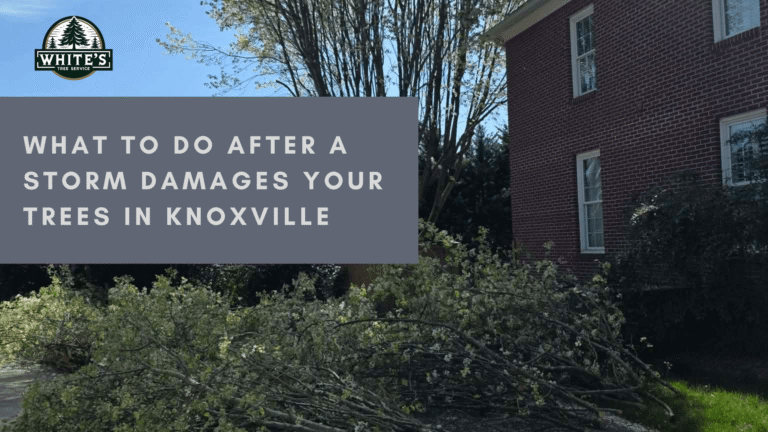
Storm-damaged trees follow different rules. A tree that’s partially fallen, split, or hanging in another tree is under tension in ways that are not obvious from the ground, and cutting into it without releasing that tension properly can cause the wood to snap unpredictably. This is one of the most dangerous scenarios in the industry, and it’s why emergency tree service crews approach storm damage differently than routine removals. If a tree is on your house, your car, or a power line, the immediate priorities are safety and scene stabilization, not efficient removal.
For any tree touching or near a downed power line, the first call should always be to KUB at (865) 524-2911, not to a tree service. No reputable Knoxville tree crew will touch a tree tangled in a live line until KUB has cleared it.
Step 6: Chipping, Log Handling, and Debris Removal
Once sections are on the ground, they get processed. This is often the longest single phase of a tree removal, and on a big tree it can take longer than the actual cutting.
Small branches and brush go into a wood chipper, which reduces them to chips that get blown into the chip truck. Chips can also be dropped in a pile on the property if the homeowner wants them for mulch. Some homeowners in Knoxville actively request chips to spread in flower beds or on paths.
Trunk sections and larger limbs are cut into manageable lengths. If the homeowner wants firewood, the crew cuts to a specified length (typically 16 to 18 inches) and stages the wood in a pile for the homeowner to split and stack. Otherwise, logs are loaded onto trucks and hauled off the property.
A note on wood disposal: under the City of Knoxville tree ordinance (Section 14-39), wood waste from any tree over 12 inches in diameter is the tree company’s responsibility to haul away. Piling it at the curb for city pickup is considered illegal dumping and can result in fines against the tree company. When you hire a professional tree service, hauling is baked into the price.
Well-run crews chip and haul as they cut rather than letting debris pile up. That keeps the site organized, reduces the walkthrough at the end, and speeds up the whole process.
Step 7: Stump Grinding (When to Add It, When to Skip It)
Removing the tree leaves a stump. What happens next depends on what you told the estimator you wanted.
Standard tree removal cuts the tree to just above ground level. Stump grinding is a separate service, usually offered as an add-on line item on the estimate. If you want the stump gone, this is where it happens.
A stump grinder is a machine with a rotating cutting wheel that shreds the stump into wood chips. Grinding depth is typically four to six inches below grade, which is enough for grass to grow over or for a shallow planter, but not deep enough to build on. If you plan to pour concrete, install a patio, or replant in the same spot, tell the crew before pricing so they can grind deeper or excavate more of the root ball.
Timing note: because Tennessee 811 requires three working days notice before excavation, some stump grinding gets scheduled as a separate visit a few days after the tree removal. This is standard practice and not a scheduling failure.
Grindings mix wood chips with the surrounding soil and leave a mound above the original grade. The homeowner has three options:
- Leave the mound and let it settle and decompose over a season
- Have the crew haul the grindings away, which is usually an added charge
- Use the grindings as mulch elsewhere on the property
When to skip stump grinding: if the stump is in a wooded area where it will decompose naturally, if you’re planning larger site work in the near future, or if the tree was small enough that the stump is barely noticeable. When to include it: if you want to mow across the area, replant grass, install landscaping, or eliminate the tripping hazard.
Step 8: Final Cleanup and Site Walkthrough
Cleanup is where a good crew earns the recommendation. The site should look as close to the way it did before the crew arrived as possible, minus the tree.
A proper cleanup includes:
- Raking the drop zone for sticks, sawdust, and bark
- Blowing chips and debris off driveways, sidewalks, and hardscape
- Removing protection mats, tarps, and any equipment
- Sweeping the street if debris landed there
- Checking the yard one final time for anything missed
Then the lead should walk the site with you (or leave a note if you weren’t home) to confirm the work matches the scope. If anything looks off, this is the moment to say something. A good tree company would rather fix a small issue on the day of the job than have you unhappy after they’ve left.
Turf disturbance is normal even with ground protection. Expect some flattening or bruising in the drop zone. In most cases the grass recovers on its own within a growing cycle. On more sensitive turf or hillside lawns, minor overseeding and topdressing may be needed.
How Long Does Tree Removal Take in Knoxville?
This is one of the most common questions homeowners ask, and the answer varies more than you might expect. A small tree in an open yard can be done and cleaned up in under an hour. A large hazard tree over a house can take a full day, sometimes two.
Here are realistic time ranges for standard residential jobs in Knox County, assuming reasonable access and no unusual hazards:
Small Trees (Under 20 Feet)
Total time: 30 minutes to 2 hours. This includes setup, felling or dismantling, chipping, and cleanup. Ornamental trees like dogwoods, redbuds, and crabapples usually fall in this category. Cleanup often takes as long as the cutting on these smaller jobs.
Medium Trees (20 to 50 Feet)
Total time: 2 to 5 hours. Most residential tree removals in Knoxville fall in this range. Includes typical Bradford pears, medium pines, smaller maples, and similar. Nearly always requires sectional dismantling on suburban lots. Chipping and hauling become significant time drivers as the tree gets larger.
Large Trees (50 to 80 Feet)
Total time: 5 to 10 hours, sometimes a full day. Common in this range: mature red oaks, tulip poplars, hickories, and larger pines. Often requires a bucket truck or crane depending on access. Multiple truckloads of debris. The rigging and controlled dismantling take real time on trees this size, especially near structures.
Very Large Trees (80 Feet and Up)
Total time: a full day to multi-day project. White oaks, sycamores, and largest tulip poplars often reach this size in older Knoxville neighborhoods. Almost always requires a crane and a larger crew. Staging, dismantling, and cleanup all scale up. Some jobs are split across two days when access limits how much debris can be processed in a single visit.
Access is the single biggest time modifier beyond size. A 60-foot tree in an open front yard with driveway access might take four hours. The same tree in a fenced backyard requiring hand-carry of every branch through a narrow gate might take twice as long.
Do You Need to Be Home During Tree Removal?
You do not need to be home while the crew is working. Most tree removal jobs in Knoxville are done with the homeowner at work, running errands, or otherwise off site. As long as the scope has been agreed to in writing, the crew has access, and any pets are contained, the job runs the same whether you’re there or not.
Being home helps in a few specific cases:
- First time working with a company, when you want to see how they operate
- Complex jobs with multiple trees or optional decisions to make during the removal
- Trees near sensitive features where you want to point out priorities in person
- Anything where you want a walkthrough at the end rather than a note
Being home can also slow the job down slightly, especially if you want to talk with the crew during work. Chainsaw crews cannot safely have conversations while cutting, so extended chat time is time not spent on the tree.
If you can’t be home, leave a phone number where the lead can reach you if anything comes up. Most decisions can be handled with a quick call.
Tree Removal Near Power Lines in Knoxville: What Actually Happens
Trees near power lines are the highest-risk category of residential tree removal. Roughly ten to fifteen percent of tree removal jobs in Knox County involve some level of utility line consideration, and the wrong move around energized lines can be fatal.
Here’s how a professional Knoxville tree service handles trees near power lines:
The 10-foot rule
Any tree work within approximately ten feet of a primary distribution line (the top wires on the pole) is not standard tree work. It requires utility coordination or specialized line-clearance certification. Any legitimate crew treats this as a KUB matter, not a chainsaw matter.
Coordination before scheduling
For qualifying jobs, the tree service contacts KUB in advance. KUB may send their own line-clearance crew to remove the tree at no cost to you, may de-energize the circuit temporarily so the private crew can work safely, or may sign off on a plan that keeps all work outside the safe clearance zone.
Service drops to the house
The lower wires running from the pole to your home (service drops) are generally the homeowner’s responsibility to keep clear. Vegetation touching a service drop is still a shock and fire risk, and a good tree service can work around them safely, but this still requires care.
Downed lines after storms
A tree that has already fallen on a power line is not a tree service call. It is a KUB call, at (865) 524-2911. No tree crew should approach a tree tangled in a live line. The line is treated as energized until KUB confirms otherwise. Once the line is cleared or de-energized, the tree can be safely removed.
If you’re getting quotes on a tree near power lines and one company says they can just do it without any KUB involvement, that’s a serious red flag. Cheap and dangerous are not the same thing.
Red Flags: How to Tell You’re Dealing With a Bad Tree Company
Every legitimate tree service in Knoxville operates within certain baseline standards. Companies that skip these are either inexperienced, uninsured, or knowingly cutting corners. Here’s what to watch for.
Door-to-door solicitation
Storm-chasers roll through Knox County after every major weather event knocking on doors and claiming to be “already in the area with equipment.” Legitimate local companies rarely operate this way. If someone shows up at your door offering to take a tree down right now for cash, decline politely and get a real quote from an established company.
No written estimate
If the number is verbal, there’s no scope. Without a written scope, disputes about what was included, what happens with the stump, who handles debris, and what the crew is liable for turn into your problem after the fact.
No proof of insurance
Real tree companies carry general liability insurance and worker’s compensation. Both should be verifiable on request. If a worker gets hurt on your property or the crew damages your house and the company isn’t properly insured, the liability can land on you.
Payment demands upfront
Standard practice is a payment schedule with most of the fee due on completion. A demand for full payment before work starts is a warning sign.
Unmarked trucks and no local presence
Trucks without company signage, no local address, no online reviews, and no verifiable phone number often mean fly-by-night operators.
Not registered with the City of Knoxville Tree Maintenance Registry
Section 14-39 of the Knoxville code requires any company doing tree work on trees over 12 inches in diameter within the city to register with the urban forester. The registry is free, and companies not on it may face stop-work orders. It’s a low bar, and a company that hasn’t cleared it is telling you something about their business practices.
Subcontracted work
Some companies advertise as tree services but pass the actual job to a subcontractor you never met. The professional tree removal service you hired should be the one doing the work, and any subcontracting should be disclosed upfront.
What About Cost?
Pricing isn’t the focus of this guide because it depends heavily on the specifics of your tree. What we can tell you is that tree removal in Knoxville generally ranges from a few hundred dollars for small ornamentals to several thousand for large hardwoods requiring crane work.
For a detailed breakdown of what drives price on real Knoxville jobs, see our full guide to tree removal cost in Knoxville TN, which covers pricing by tree size, factors that push cost up, and how to save money without cutting corners on safety.
FAQs About the Tree Removal Process in Knoxville
How long does tree removal take in Knoxville TN?
Most residential tree removals in Knoxville take between 2 and 8 hours from crew arrival to final cleanup. Small ornamentals can be done in under 2 hours. Medium trees (20 to 50 feet) typically take 2 to 5 hours. Large hardwoods (50 to 80 feet) usually take a full day. Very large trees over 80 feet, or removals requiring crane work near structures, can take a full day or occasionally spread across two days.
Do you need to be home for tree removal?
No, you do not need to be home during a tree removal. As long as the scope is in writing, the crew has property access, and pets are contained, most Knoxville tree removals are done with the homeowner off site. Being home is helpful for first-time jobs, complex removals with in-the-moment decisions, or if you want a walkthrough at the end rather than a note.
How does a tree company remove a large tree near a house?
Large trees near houses are removed by sectional dismantling. A climber ascends the tree with rope and saddle gear, cuts branches and trunk sections one at a time from the top down, and rigs each piece with ropes so it lowers safely to the ground rather than falling. For the largest trees or the highest-risk over-house removals, a crane is often used to lift sections straight up and away from the property to a staging area for processing.
Do you need a permit for tree removal in Knoxville?
Most private residential tree removals in Knoxville do not require a permit. The City of Knoxville Tree Protection Ordinance exempts single-family and two-family dwellings, so a tree in your own yard can typically be removed without city paperwork. Permits are required for trees in the public right-of-way, for designated heritage or landmark trees, for commercial or development sites, and when a lot has no dwelling on it.
Does tree removal include stump grinding?
Standard tree removal cuts the tree to just above ground level and leaves the stump. Stump grinding is a separate service that’s usually offered as an add-on line item on the estimate. If you want the stump gone, make sure it’s included in your written scope. Grinding is typically done to a depth of 4 to 6 inches below grade, which is enough for grass to grow over or for shallow landscaping.
What happens with tree debris after removal?
Standard practice for professional tree removal in Knoxville is for the crew to chip all brush and haul away all logs and debris. Chips can be left on the property as mulch if requested. Firewood-length logs can be staged for the homeowner if requested. Under Section 14-39 of the Knoxville code, wood waste from trees over 12 inches in diameter is the tree company’s responsibility to remove, and placing it at the curb for city pickup is considered illegal dumping.
What happens if the crew damages my property during removal?
Any reputable licensed and insured tree removal company in Knoxville carries general liability insurance specifically for accidental property damage. If a limb comes down wrong and cracks your gutter or a piece of equipment scuffs your driveway, the company’s insurance handles the repair. This is why hiring an insured company matters. Uninsured contractors leave you paying for their mistakes.
Ready to Schedule a Tree Removal in Knoxville?
Whites Tree Services has been handling residential tree removal in Knoxville TN and the surrounding counties since 2014. Every job is owner-operated by Chris White and his crew, never subcontracted. We’re a fully licensed and insured tree removal company, registered with the City of Knoxville Tree Maintenance Registry, and we follow ANSI A300 pruning standards where they apply. Our reputation is built on 90+ five-star Google reviews from homeowners across Knox County, Loudon County, and Blount County.
If you have a tree that needs to come down, or you’re not sure whether it needs to come down at all, we offer free written estimates across the greater Knoxville area. For full-service tree removal Knoxville TN homeowners can trust, or to schedule a site visit, request an estimate here or call us at (423) 519-7484. We’ll walk your property, assess what needs to happen, and give you a straight answer with a written price. No high-pressure sales, no vague quotes, and no surprises after the work starts.