Warning Signs Your Tree Needs to Be Removed
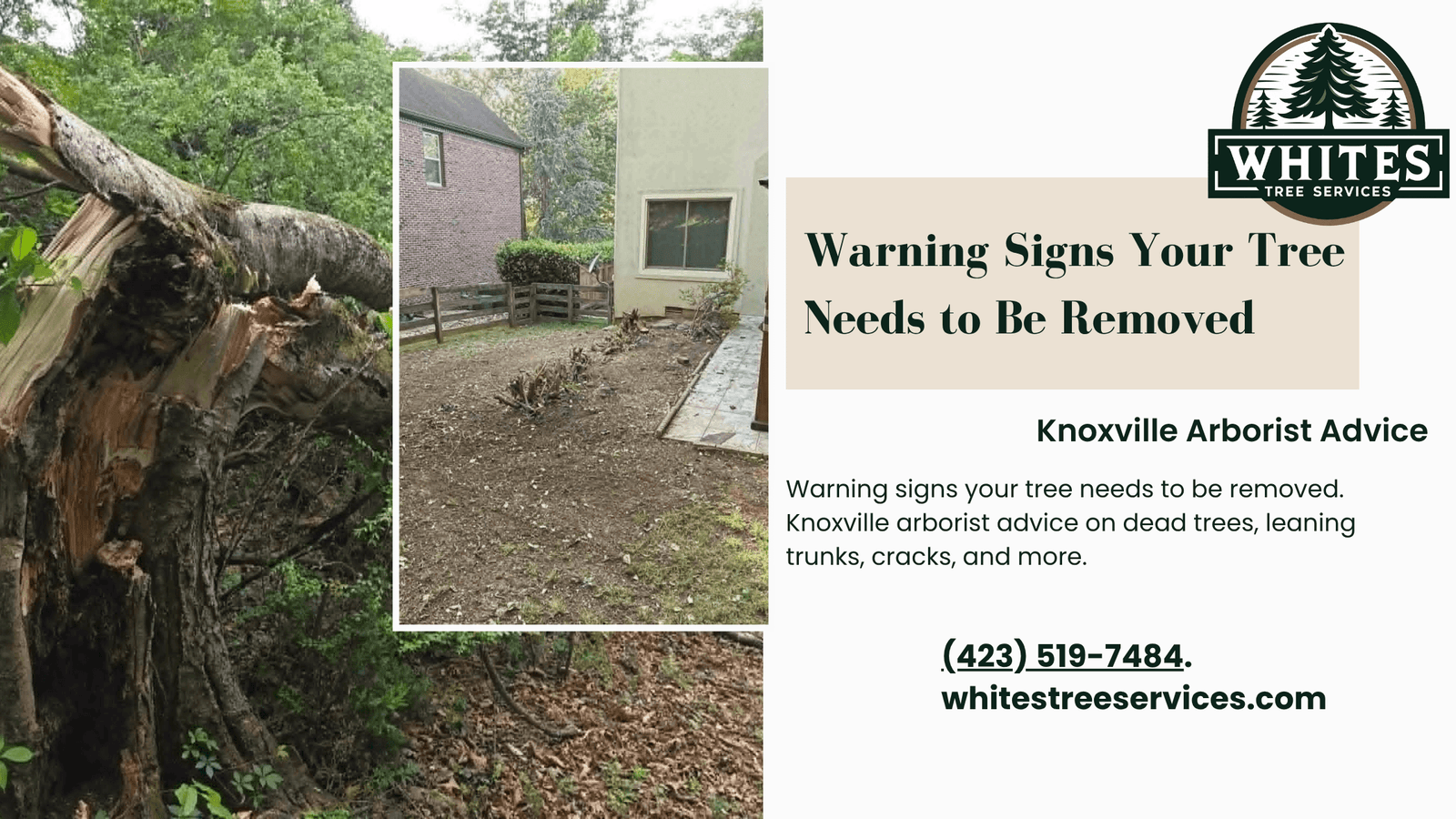
Some trees should not be standing anymore. They might look fine to a casual glance, but a trained eye can spot the warning signs your tree needs removal from across the yard. Knowing what those signs are could mean the difference between a planned $1,000 removal during good weather and a $5,000 emergency call after a thunderstorm tears your roof open.
This is the kind of knowledge homeowners almost never get until they need it. The arborist comes out, points at the tree, says “yeah, that needs to come down,” and you wonder how you missed it. We are going to fix that.
As a trusted arborist in Knoxville, our crew has evaluated hazardous trees across Knox, Loudon, and Blount counties for over a decade. We have seen the same warning patterns over and over, and we have watched what happens when those signs get ignored. The trees that fail in storms are almost always the ones that were trying to tell their owners something for years.
If you spot two or more of the seven signs in this guide on the same tree, you need a professional opinion. If you spot three or more, you almost certainly need that tree gone before the next big storm.
Why Knowing These Signs Could Save You Thousands
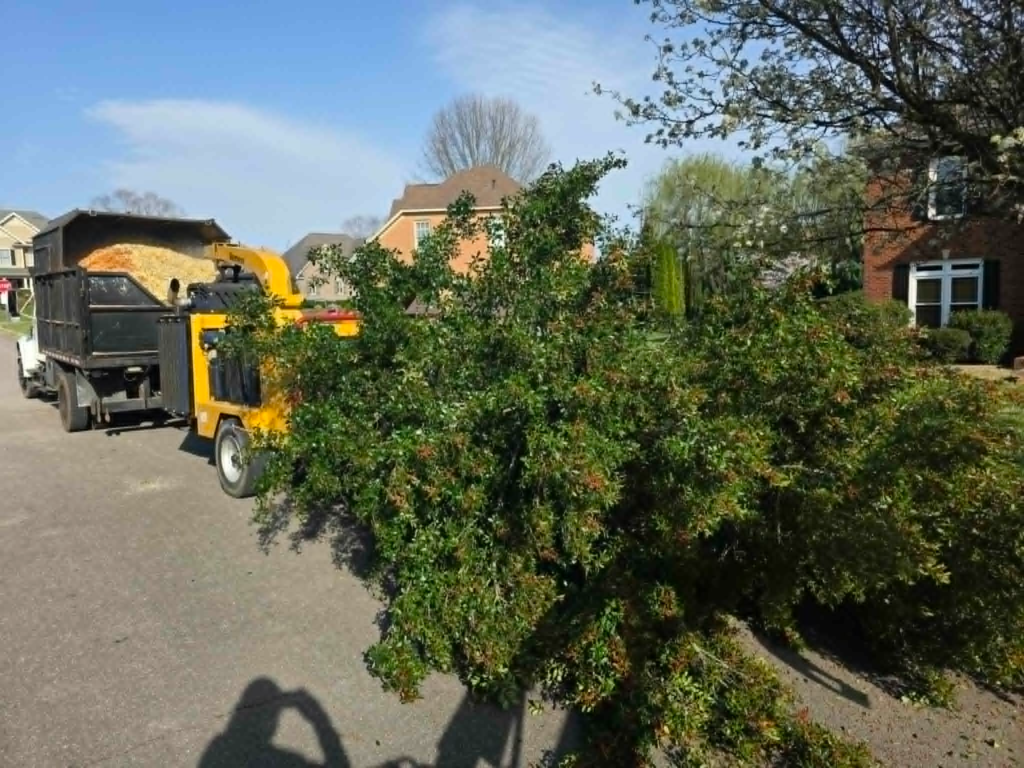
Tree removal is not cheap. A typical removal in Knoxville runs anywhere from $500 to $3,000 depending on size and complexity. Emergency removal after a tree has fallen runs significantly higher, often double or triple.
But the bigger numbers are what comes after a tree failure: roof repairs, gutter replacement, totaled vehicles, fences flattened, sometimes injuries. We have seen homeowner insurance claims for fallen-tree damage routinely run $15,000 to $50,000. And in many cases, the insurance company pushes back on the claim because the tree showed obvious signs of decay before it fell.
| The Insurance Trap Most Homeowners Don’t Know About Insurance policies cover storm damage, not maintenance failures.If a tree fell because of a sudden storm and was previously healthy, your claim is straightforward.If a tree fell because it was rotted, hollow, or visibly declining, your insurance company can argue you should have removed it sooner.Result: claim denied, you pay for the damage out of pocket.Documenting tree health (or removing trees that show warning signs) protects you both ways. |
Removing a problem tree before it fails is almost always cheaper than dealing with the aftermath. That is the math. Now let’s talk about how to spot the trees that should not still be standing.
How Trees Actually Fail (and Why Most Homeowners Miss It)
Trees do not usually fail randomly. They fail in predictable patterns based on the type of damage they have. Knowing those patterns helps you understand what each warning sign actually means.
The Four Types of Tree Failure
- Root failure: The tree falls over from the roots up. Usually involves saturated soil, root rot, or root damage from construction. The whole root plate lifts.
- Trunk failure: The tree breaks somewhere along the main trunk. Usually involves internal decay, cracks, or hollow sections.
- Branch failure: Individual branches break and fall. Usually involves weak attachment points, deadwood, or storm load.
- Crown failure: The top of the tree breaks off. Often related to pest damage like EAB, lightning strikes, or weak codominant stems.
Each warning sign in this guide points to one or more of these failure types. The trick is recognizing which type you might be looking at, and how serious it actually is.
Warning Sign 1: Heaving Soil and Root Plate Failure
This is the most dangerous warning sign on the list, because by the time it is visible, the tree is already failing. It is not a question of if; it is a question of when.
Walk around the base of any large tree on your property. Look at the soil right at the trunk. Is the ground level all the way around? Or is it lifted up on one side, with cracks in the soil, exposed roots, or a noticeable mound where there should not be one?
Why This Happens in Knoxville
East Tennessee’s clay-heavy soil has poor drainage. After heavy spring rain, the soil around tree roots becomes saturated and soft. When wind hits the canopy of a large tree, the force gets transferred down to the root system. In normal conditions, the roots hold. In saturated soil, they pull free.
As the root plate begins to fail, you see physical evidence at the surface: soil heaving up, cracks radiating out from the trunk, sometimes a slight tilt to the tree itself. We see this most often after extended rainy periods, especially late April through May.
What to Do
Stay away from the tree. Get everyone (people, pets, parked cars) out of the fall zone, which extends about 1.5 times the tree’s height in any direction the tree might fall.
This is not a watch-and-wait situation. Call for a professional removal as soon as possible. A tree with active root plate failure can fall in any wind, sometimes in no wind at all.
Warning Sign 2: Vertical Trunk Cracks and Splits
Some bark texture is normal. Trees like River Birch shed bark naturally as part of healthy growth. Sycamores have a patchy, peeling appearance. The signs you are looking for are different: deep cracks that go past the bark and into the wood itself.
The Two Worst Crack Patterns
First, vertical cracks running up and down the trunk. These usually develop slowly, often around the location of an old wound or a weak section. Wind stress flexes the trunk repeatedly, the crack widens over time, and eventually the tree splits along the crack line.
Second, the dreaded V-crotch crack. When two main stems grow up from the same point in a tight V-shape (codominant stems), bark gets pinched between them. As the tree grows, the pressure increases. Eventually a crack forms right at the meeting point. Once you see a crack at a V-crotch, the tree is on borrowed time. We have removed countless half-fallen Bradford pears, silver maples, and red maples that failed at exactly this point.
How to Tell If a Crack Is Serious
- Goes deeper than the bark, into the lighter-colored wood underneath. Surface bark cracks are usually fine. Deep cracks are not.
- Has a visible gap you can fit a coin into. The wider the gap, the worse the structural failure.
- Has spread or widened since you noticed it. Take a photo this month, another next month, and compare.
- Located at a stress point, like a V-crotch or where a major branch attaches.
- Has signs of decay or fungus inside the crack.
Warning Sign 3: Hollow Cavities and Internal Decay
A hollow tree is not always a dead tree. Some species (oaks especially) can live for decades with significant internal decay, as long as the outer ring of sound wood is thick enough to provide structural support. But hollow trees are always weakened, and the question is how much.
The 33% Rule
Arborists use a general guideline called the 33% rule. If more than one-third of a tree’s cross-section is hollow, decayed, or otherwise structurally compromised, the tree is considered a high risk for failure and removal is usually recommended.
How do you measure that? You can’t, not from the outside. Trained arborists use specialized tools called resistographs that drill tiny diagnostic holes into the trunk and measure the wood density. The data tells us exactly how much sound wood remains and where the hollow areas are.
Surface Signs of Internal Decay
- Visible cavities, gaps, or holes in the trunk at any height.
- Soft, spongy wood you can press into with a finger or a stick.
- Hollow sound when you tap the trunk with a hammer (sound wood has a solid, dense ring).
- Carpenter ants or other insect activity. Carpenter ants nest in dead, decaying wood. If you see them at the base of a tree, decay is present.
- Bark coming off in large patches, exposing punky or rotted wood underneath.
If you suspect internal decay on a tree near your house, schedule a tree assessment with a professional who has the right diagnostic tools. Internal decay is invisible from the outside, and educated guesses can go either way.
Warning Sign 4: Mushrooms and Fungal Growth at the Base
Mushrooms growing on a tree or at its base are often the first visible sign of a problem that has been developing underground for years. The mushroom is just the fruiting body, the visible part of a much larger fungal network that has been breaking down the wood from the inside.
The Worst Offenders
- Armillaria (honey mushrooms): Causes root rot in many tree species. Mushrooms appear in clusters at the base in fall.
- Ganoderma (artist’s conk): Large, hard, shelf-like fungi that grow on trunks and roots. Indicate severe heart rot.
- Inonotus dryadeus (oak bracket): Common on oaks. Causes butt rot at the base, leading to root and lower trunk failure.
- Phaeolus schweinitzii (dye polypore): Causes brown cubical rot in conifers, especially pines.
Why Fungus Is Such a Bad Sign
By the time you see fungal fruiting bodies on the outside, the rot inside is well-established. The fungus has been working through the wood for years, sometimes a decade or more. The visible mushroom is just the tip of the iceberg.
Fungal decay weakens load-bearing wood in unpredictable patterns. A tree with significant fungal damage can stand for years and then fail suddenly during a storm that other healthy trees nearby shrug off. This is exactly the kind of “unexpected” tree failure that catches homeowners off guard.
Not all fungus is a death sentence. Surface molds, lichens, and moss are usually harmless. The serious offenders are the wood-decaying fungi that fruit from inside the trunk or root system. When in doubt, get an expert opinion.
Warning Sign 5: Sudden or Pronounced Leaning
Trees lean. That is normal. They lean toward the light, away from competition, with the prevailing wind. A natural lean that has been there for years is usually not a problem.
The signs to watch for are sudden changes. A tree that was straight last year and is now noticeably tilted. A lean that has gotten worse since the last storm. A tree that suddenly has soil cracking on the side opposite the lean.
How to Measure for a Sudden Lean
Take photos of your large trees once a year, from the same spot, in the same season. Year over year, you can compare and notice any changes. A degree or two of tilt is usually nothing. A 5 or 10 degree shift is alarming.
Even a static lean of more than 15 degrees from vertical is considered a warning sign. The further from vertical, the more stress on the root system and the more likely the tree is to fail in a storm.
When a Lean Becomes an Emergency
If a tree leaning toward your house, a power line, your driveway, or any other valuable target shows any of the following, treat it as an emergency:
- Visible soil heaving on the side opposite the lean.
- Cracks in the soil radiating out from the base.
- New change in lean since recent rain or storm.
- Roots visibly lifting out of the ground.
- Audible creaking or movement on calm days.
All of those symptoms together mean the tree is actively falling, just slowly. Call for emergency tree service right away.
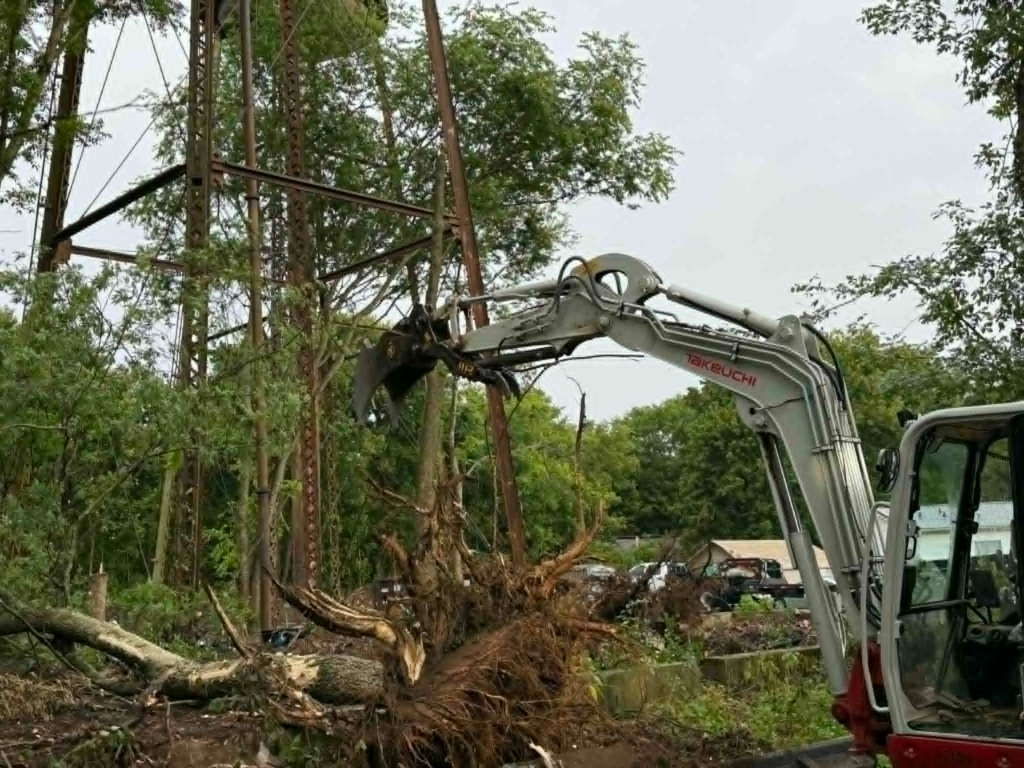
Warning Sign 6: Crown Dieback and Dead Wood
Look at the very top of your trees. The highest branches should leaf out fully every spring and stay green through summer. If they don’t, something is wrong.
Crown dieback (where the top of the tree thins out, fails to leaf, or has obviously dead branches) is one of the clearest early warning signs of a tree in decline. The tree is essentially giving up on its highest, hardest-to-reach branches first because it cannot get enough water and nutrients up there.
What Causes Crown Dieback
- Pest infestation: Emerald Ash Borer is the biggest culprit in Knoxville right now. EAB always kills from the top down.
- Vascular disease: Conditions like oak wilt or bacterial leaf scorch disrupt the tree’s plumbing, starving the canopy from below.
- Root damage: If the roots have been compromised by construction, soil compaction, or rot, the upper canopy suffers first.
- Drought stress: Extended dry periods can permanently damage upper branches even after water returns.
- Lightning damage: Strikes often kill the top of a tree even when the lower trunk survives.
If the tree in question is an ash, you are almost certainly looking at EAB damage. Our complete guide on emerald ash borer identification and treatment covers what to look for and whether treatment is still an option.
Dead Wood Is Always a Hazard
Even on otherwise healthy trees, dead branches are dangerous. They become brittle, lose their flexibility, and break easily. Large dead branches over driveways, patios, or walkways are accidents waiting to happen.
If a tree has multiple large dead limbs, especially in the upper canopy where they are hard to remove safely, the math often favors removing the whole tree rather than just trimming. Pruning out major deadwood is expensive and difficult, and the underlying cause that killed those branches is usually still at work in the rest of the tree.
Warning Sign 7: Bad Location (Trees in the Wrong Place)
Sometimes a tree is healthy. Beautiful, even. But it is in the wrong place. As trees grow over decades, they can put you in a position where keeping the tree creates more risk than removing it.
Common Wrong-Place Situations
- Trees too close to the house: Roots can damage foundations and underground plumbing. Branches scrape against siding and roofs. In a storm, the entire tree is a potential weapon pointed at your home.
- Trees over septic systems or septic fields: Roots seek out the moisture and nutrients in septic systems and tear them apart from below.
- Trees growing into power lines: Fire hazard, neighborhood-wide outage potential, and constant utility company conflict.
- Trees lifting driveways and sidewalks: Roots displace concrete and asphalt, creating tripping hazards and ongoing repair costs.
- Trees next to swimming pools: Constant debris in the water, root damage to the pool deck, and shade that prevents pool use.
The Hard Decision
Removing a healthy tree feels wrong, especially a mature one. Plenty of homeowners try every alternative before they accept that removal is the right call. Sometimes there is no good alternative.
The good news is that removal followed by smart replanting often gives you a better long-term result. The right tree in the right place will grow well, look great, and not threaten your home. The tree that was planted 50 years ago when nobody thought about mature size? It might just need to go.
High-Risk Tree Species in Knoxville
Some species are simply more prone to failure than others. If you have any of these on your property, give them extra attention.
Bradford Pear (Pyrus calleryana)
Banned for sale in Tennessee, and for good reason. Notoriously weak branch unions that split apart in any decent storm. Predictable failure pattern at the V-crotch in the lower canopy. If you have a Bradford pear larger than about 20 feet tall, it is on borrowed time. Strongly consider proactive removal.
Silver Maple (Acer saccharinum)
Fast-growing, but the wood is famously brittle. Branches snap easily under ice load, wind, or even just their own weight as they extend horizontally. Shallow root systems also make them prone to blowdowns. Common in older Knoxville neighborhoods, often planted as fast-growing shade trees decades ago and now becoming liabilities.
Ash Trees (Fraxinus species)
With EAB widespread in Knox County, untreated ash trees are essentially on a countdown. Once they show major symptoms, decline is rapid. And dead ash wood becomes brittle within months, making removal increasingly dangerous the longer you wait.
Leyland Cypress
The most-planted privacy tree in East Tennessee, and a constant source of failure problems. Fast growers with shallow root systems and tops that get heavy enough to topple. Once they reach about 40 feet, they become increasingly likely to lean or fall in storms.
Sweetgum (Liquidambar styraciflua)
Solid wood, but their root systems aggressively lift pavement, foundations, and underground utilities. Their gumball seed pods are also a constant nuisance. Often planted in the wrong place and then becoming a property damage source for decades.
Norway Maple (Acer platanoides)
Aggressive surface roots that lift pavement and damage lawns. Susceptible to verticillium wilt, which causes sudden branch dieback. Considered invasive in many areas. Generally not a great choice for residential yards.
The Cost of Waiting: Why Procrastination Backfires
Almost every emergency tree removal we do started as a problem somebody could have addressed earlier. The tree that fell on the roof at 3 a.m.? It was leaning weird for two years. The branch that crushed the parked car? It had been dead all summer. The tree that took out the fence? The mushrooms at the base were obvious to anyone who looked.
Waiting almost always makes things worse:
- Costs go up. A planned removal in good weather is far cheaper than emergency response. We typically charge 30 to 50% more for emergency work because of urgency, after-hours scheduling, and the higher complexity of working with already-failed trees.
- Risk increases. Dead trees become brittle. Hollow trees collapse further. Leaning trees lean more. The longer you wait, the worse the situation gets, and the more dangerous the removal becomes.
- Damage spreads. A failing tree may take other trees with it when it goes. We have seen one tree fall and damage three or four neighbors before stopping.
- Insurance gets complicated. Failed-tree damage may be denied or reduced if the tree showed signs of decline before failure.
If you are weighing whether to address a problem tree, look at it this way: what would it cost to remove proactively? What would it cost if it fails on something? Multiply the failure cost by even a small probability and the math becomes obvious. Our tree removal pricing guide gives you a starting point for the proactive removal cost.
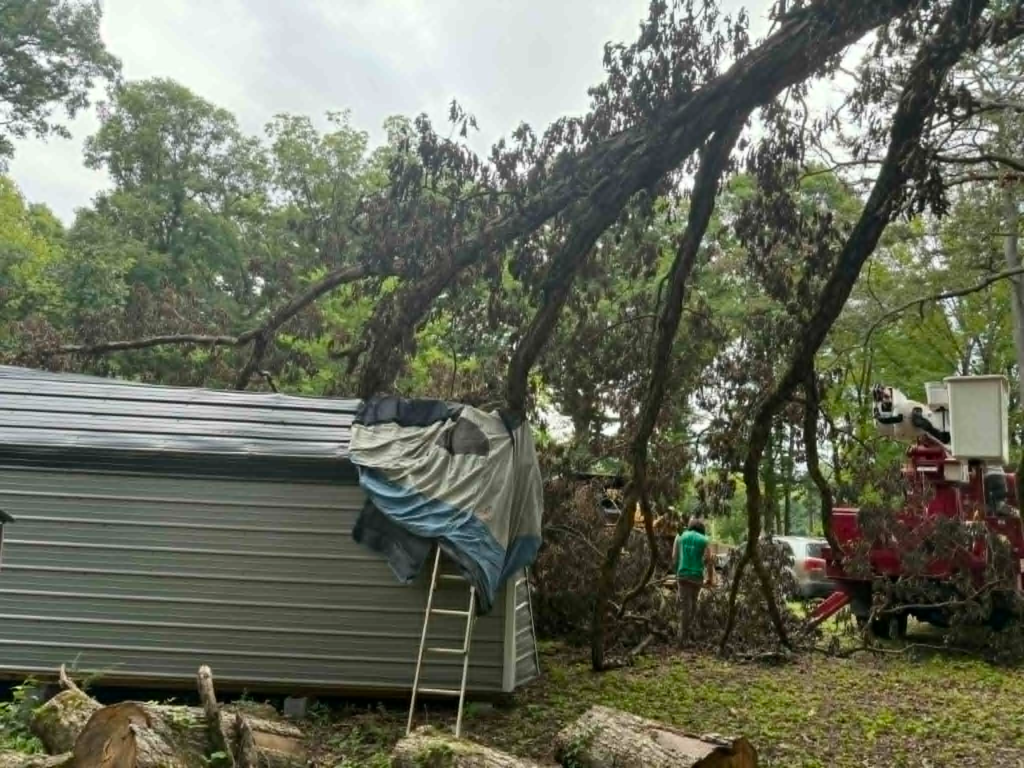
When to Call a Pro vs. When to Watch and Wait
Not every concerning tree needs to come down today. Some can be monitored, treated, or partially addressed with pruning or cabling. Here is how to think about it.
Call a Pro Now
- Any tree leaning toward a structure, even slightly.
- Visible root plate failure or heaving soil.
- Major trunk cracks or splits.
- Large dead limbs over high-traffic areas.
- Mushrooms or fungal conks at the base.
- Any tree that has dropped multiple major limbs in recent years.
Schedule an Assessment Soon
- Crown dieback in the upper canopy.
- Smaller cracks or splits to monitor.
- Suspected disease or pest activity.
- Trees too close to structures that you are not sure about.
- Multiple smaller warning signs on the same tree.
Watch and Wait
- Healthy-looking trees with no obvious symptoms.
- Trees with cosmetic issues like surface bark damage that is healing.
- Trees that have been there for decades and shown no recent changes.
- Annual professional inspections for trees of significant size or age.
For anything in the first or second category, our team offers safe tree removal in Knoxville with full insurance and ISA-trained staff. We will give you an honest assessment, including telling you when a tree does not actually need to come down.
What Happens During a Professional Tree Assessment
A lot of homeowners are nervous about getting a tree assessment because they assume the company will pressure them into expensive work. That is not how a legitimate operation works. Here is what to expect from a real assessment.
The Walk-Around
The arborist starts by walking the property and looking at every significant tree. They are looking at branch structure, trunk condition, root flare, soil around the base, signs of pests or disease, and the relationship between the tree and any nearby structures. This part takes 15 to 30 minutes for a typical residential property.
The Diagnostic Tools
For trees of concern, the arborist may use specialized tools:
- Sounding mallet: Tapping the trunk to listen for hollow sections.
- Resistograph: A specialized drill that measures wood density and detects internal decay.
- Increment borer: A small tool that extracts a thin core sample from the trunk to assess wood condition.
- Aerial inspection: For some trees, climbing up to inspect upper canopy issues directly.
The Recommendation
After the inspection, the arborist gives you a clear recommendation: leave it alone, prune it, treat it, monitor it, or remove it. A good arborist will explain their reasoning, walk you through what they saw, and answer your questions. They will not pressure you to make a decision on the spot.
You should also get a written estimate that breaks out the work clearly. If the recommendation is removal, the estimate should include tree removal, stump grinding (or stating that it’s not included), debris removal, and any other line items separately.
Frequently Asked Questions
How can I tell if a tree is dying or just stressed?
A stressed tree may have temporarily thin canopy, off-color leaves, or slow growth, but it will respond to good care over a season or two. A dying tree continues to decline despite improving conditions, shows progressive crown dieback, and develops other warning signs over time. When in doubt, an arborist can tell the difference.
My tree is leaning. Does that mean it has to come down?
Not necessarily. A long-standing lean that has not changed is usually fine. A new lean, especially with soil heaving on the opposite side, is a serious problem. The age and progression of the lean matter as much as the lean itself.
What if my neighbor’s tree is showing warning signs?
Tennessee follows the “Hawaii Rule” for trees crossing property lines. You can trim branches that hang over your property line at your own expense. If a clearly hazardous tree on your neighbor’s property could damage your home, you can document the condition and notify your neighbor in writing. If they fail to act and the tree damages your property, you may have grounds for a claim against them rather than just relying on your own insurance.
How much does a professional tree assessment cost?
Many companies offer free assessments for residential properties, especially as part of a removal estimate. More detailed risk assessments (with diagnostic tools and written reports) typically run $150 to $400. Worth every penny if it tells you definitively whether a tree is safe.
Can a tree with a hollow trunk really be safe?
Sometimes, yes. The 33% rule is a guideline, not an absolute. A large oak with a 30% hollow trunk and thick sound wood around it might stand safely for decades. The same hollow on a smaller tree with thin trunk walls would be dangerous. Context matters, which is why professional assessment is valuable.
How often should I have my trees inspected?
Annual inspections are ideal, especially in late winter or early spring. Trees over 30 feet tall, trees within striking distance of structures, and trees in declining condition should be inspected every year without exception. Smaller landscape trees can sometimes go 2 to 3 years between professional looks.
Will removing a hazardous tree affect my home’s value?
Generally no, and it can actually improve value by removing a liability. Buyers and home inspectors flag hazardous trees during real estate transactions. A tree that is clearly going to fail is a negative on a property listing. A clean, well-maintained yard with healthy trees is a positive.
What other warning signs should I know about?
Beyond the seven covered here, there are species-specific issues worth knowing. Our guide on emerald ash borer identification covers ash-specific warning signs. We are also working on guides for oak wilt, anthracnose, and other regional concerns. The general rule: if something looks different than it did a year ago, it is worth investigating.
Your Tree Safety Inspection Checklist
Print this out and walk every tree on your property at least once a year. If you check yes on more than one item, get a professional opinion.
- Soil heaving, cracks, or unevenness around the base.
- Vertical cracks or splits in the trunk.
- Hollow areas, soft wood, or visible cavities.
- Mushrooms or fungal conks anywhere on the tree.
- Sudden or pronounced lean (especially toward structures).
- Dead branches in the upper canopy.
- Bark falling off in large patches.
- Carpenter ants, bees, or other significant insect activity.
- Branches growing into your house, roof, or power lines.
- Visible damage from previous storms that was never addressed.
- New or worsening symptoms compared to last year.
If your inspection turns up concerns, get a free estimate from our crew. We will walk the property with you, point out what we see, and tell you straight what needs to happen and what can wait. No pressure, no upselling, just an honest evaluation from people who do this work every day.
We serve Knoxville, Knox County, Lenoir City, Loudon County, Maryville, Farragut, and Blount County. Reach us at (423) 519-7484 or visit Whites Tree Services online.
The trees on your property tell a story if you know how to read it. Some of them are perfectly healthy, will be there for your grandkids, and need nothing more than occasional attention. Others are warning you that their time is running out. Knowing the difference is the first step to keeping your family safe and your property protected.