How to Save a Stressed Tree in Knoxville: Signs, Causes, and Recovery Steps
There is a specific moment every homeowner recognizes when their favorite tree starts looking wrong. Maybe the leaves are turning brown in August when they should still be green. Maybe there are dead branches at the top that were fine last year. Maybe the whole tree just looks tired, like it is barely making it. That gut feeling that something is not right is almost always correct.
The good news is that many stressed trees in Knoxville can be saved if you act quickly and correctly. The bad news is that most of the well-meaning things homeowners do to help usually make the problem worse. Fertilizing a sick tree. Watering it every day. Pruning off the dead-looking branches. Every one of those instincts is wrong, and every one of them shortens the life of a tree that could have been saved.
This guide walks you through exactly how to save a dying tree in Knoxville, from spotting the earliest warning signs to knowing when it is time to call a certified arborist. It draws on the specific conditions our team at Whites Tree Services has seen on hundreds of Knox County properties, from West Knoxville to Farragut to Lenoir City. Every property is different, but the patterns repeat. Learn the patterns, and you can often save trees that otherwise would have come down.
Read straight through if this is a new problem for you. Skip to the sections that match your situation if you already know what you are dealing with. Either way, the trees on your property will benefit from you knowing this.
What Tree Stress Actually Is (and Why It Matters)
A stressed tree is not necessarily a dying tree. Stress is what happens when a tree cannot get enough of what it needs to function normally: water, nutrients, oxygen at the roots, or protection from pests and disease. Under normal conditions, trees have massive reserves. They can lose 20 to 30 percent of their leaves, take significant root damage, or go through a bad drought and bounce back the next year without you noticing anything was wrong.
The problem is when stress becomes chronic. When the same tree faces the same underlying issue year after year, its reserves get depleted. Its immune system weakens. Its ability to fight off insects and diseases drops. At some point, the tree crosses a line where it can no longer recover on its own, and everything starts falling apart at once.
The tricky part is that trees fall apart slowly. A tree that is genuinely dying today probably started declining 2 to 5 years ago. What you are seeing now is the visible end of a long process. Which means the trees that look stressed but not dead yet are actually the ones most worth saving, because they still have enough life left to respond to good care.
Catching a tree in the middle of decline is the goldilocks zone for recovery. Too early, and you might not spot the signs. Too late, and no amount of care will bring it back. Right in that middle window, informed action can add decades to a tree’s life.
The 8 Warning Signs Your Tree Is In Trouble
Trees do not talk, but they communicate constantly through visible symptoms. Learning to read these signs is the first step in saving a stressed tree. Some symptoms are obvious. Others are subtle enough that most homeowners miss them until the damage is severe.
Sign 1: Canopy Dieback From the Top Down
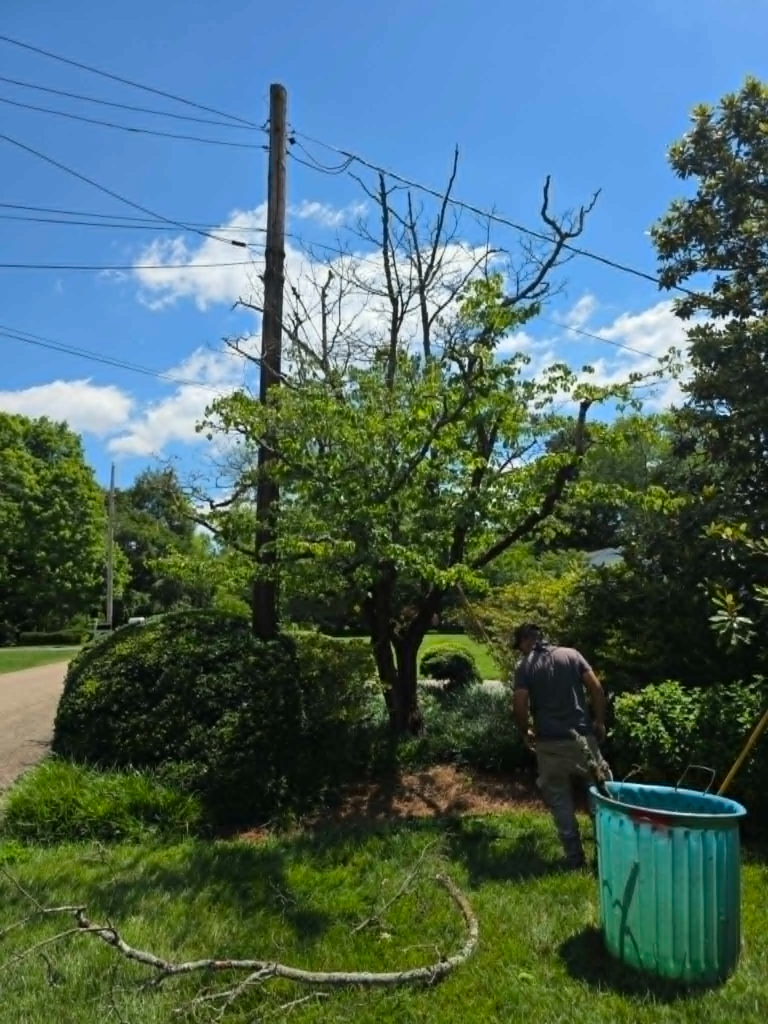
This is the single most reliable early indicator of serious tree trouble. Healthy trees have full canopies. Trees in decline start losing leaves at the very top and outermost branches first, because those are the hardest points to move water and nutrients to. If you see bare branches at the top of an otherwise leafy tree, the tree is telling you something is wrong at the root level.
On ash trees in Knoxville, top-down canopy loss almost always means Emerald Ash Borer. On oaks, it can mean bacterial leaf scorch, root damage, or drought stress. On any species, it is a signal that requires investigation.
Sign 2: Premature Leaf Color or Leaf Drop
Trees dropping leaves in July or turning fall colors in August are not celebrating an early autumn. They are conserving energy because they cannot sustain their full canopy. Premature color change is one of the most common early warning signs of drought stress, root damage, or vascular disease.
This is different from normal seasonal shedding. Small amounts of leaf drop throughout summer are normal. Widespread color change or leaf loss well before fall means something is wrong.
Sign 3: Leaf Scorch
Leaf scorch shows up as brown, crispy edges on leaves, often with a sharp line between the healthy green center and the dead brown margin. It looks like the tree got too close to a campfire. In Knoxville, leaf scorch is usually a symptom of drought stress or bacterial leaf scorch disease (especially on Red Oaks and Pin Oaks).
Widespread leaf scorch across an entire tree, especially in July and August, is a warning that the root system cannot pump water fast enough to keep up with summer evaporation.
Sign 4: Wilting Leaves That Do Not Perk Up
Leaves droop during hot afternoons and perk back up overnight. That is normal. What is not normal is leaves that stay wilted in the morning when temperatures are cool. Persistent wilting means the tree cannot maintain internal water pressure, which almost always traces back to a root problem, a vascular disease, or severe drought.
Sign 5: Epicormic Sprouts and Water Sprouts
Look at your tree’s trunk and major branches. Are there small, leafy shoots erupting where they should not be? Vertical stems growing straight up from lateral branches? Clusters of new growth around the base of the trunk?
Arborists call these epicormic sprouts, and they are almost always a stress response. The tree is essentially trying to grow new photosynthetic capacity because it has lost so much of its normal canopy that it cannot generate enough energy. When you see them, the tree is already well into decline.
Sign 6: Bark Damage, Cracks, and Cankers
Look at the trunk and major branches. Are there vertical cracks that were not there last year? Sunken, discolored patches (cankers)? Areas where bark is peeling off in large chunks?
Some bark shedding is normal (especially on Sycamores, River Birches, and Crepe Myrtles), but structural cracks and cankers are always warning signs. Cankers often indicate fungal or bacterial infection that has penetrated the bark. Cracks can indicate internal decay or extreme freeze damage.
Sign 7: Fungal Growth at the Base or on the Trunk
Mushrooms or shelf-like conks growing on or near a tree are not decorations. They are the fruiting bodies of fungi that have already established themselves deep in the wood. By the time you see visible fungal growth, the internal decay is usually well advanced.
Common offenders in Knoxville include honey mushrooms (Armillaria) at the base, artist’s conk (Ganoderma) on trunks, and various oak-specific fungi that indicate serious structural compromise.
Sign 8: Insect Activity You Did Not See Before
Stressed trees emit chemical signals that attract certain pests. Bark beetles, wood borers, and other opportunistic insects specifically target trees that are already weakened. If you notice new sawdust piles at the base of the tree, unusual woodpecker activity (they eat the borers), or visible insect activity on the trunk, the tree is likely already stressed.
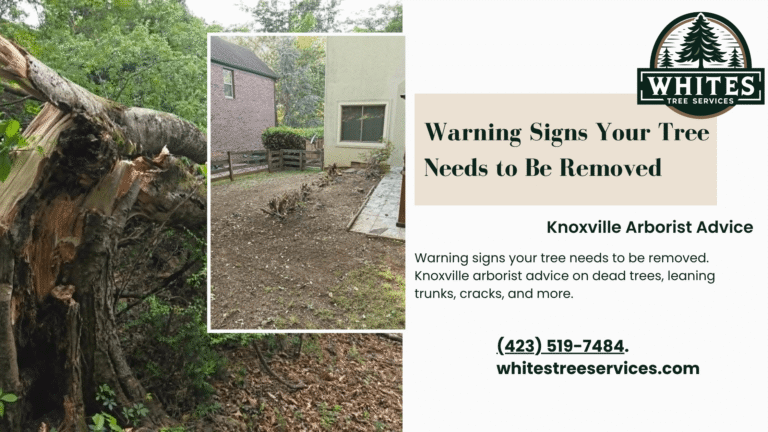
For a deeper look at when these warning signs mean removal instead of recovery, our companion guide on warning signs your tree needs removal covers the specific patterns that indicate a tree has passed the point of no return.
The Scratch Test: Is Your Tree Still Alive?
Before you invest time and money in trying to save a tree, you need to confirm it is actually still alive. The scratch test is the simplest, most reliable way to check.
Take a small twig at the end of a branch and gently scrape away the outer bark with your fingernail or a pocketknife. Look at what is underneath. Green tissue means the branch is alive. Brown, dry tissue means that branch is dead.
Test multiple branches around the tree. If most branches show green tissue, the tree still has a functioning vascular system and can potentially recover. If most branches show brown, dry tissue, the tree is either dead or so far into decline that saving it is unlikely.
Also check the main trunk. Pick a spot on the trunk with newer bark (not the thick base) and try the same scratch. Green cambium under the trunk bark is the best possible sign. Brown, dry cambium in the trunk itself is usually a death sentence.
| How to Interpret the Scratch Test Green tissue on trunk AND most branches: Good candidate for recovery. Focus on the causes and address them.Green tissue on trunk, brown on some branches: Recoverable. Some pruning of confirmed dead wood will be needed once the tree stabilizes.Brown tissue on major branches, green only near base: Serious decline. Recovery is possible but uncertain. Get professional assessment.Brown tissue on trunk itself: Tree is likely dead or dying beyond recovery. Plan for removal. |
The Most Common Causes of Tree Stress in Knoxville
You cannot fix a problem you cannot identify. Before you start any recovery steps, spend time thinking through what likely caused the stress in the first place. In Knox County, the causes fall into a predictable list.
Cause 1: Drought and Heat Stress
Knoxville summers are hot and humid, and every few years we get extended stretches with little rainfall. Trees that were not deeply watered heading into those dry periods struggle badly. Shallow root systems, which develop from years of light surface watering, cannot reach the deeper moisture that trees need to survive dry stretches.
Drought stress often shows up as leaf scorch, premature leaf drop, and canopy thinning during and after the dry period.
Cause 2: Root Damage From Construction or Landscaping
This is the invisible killer. Any digging, grading, or heavy equipment work near a tree can sever critical roots without causing any visible damage above ground. The symptoms show up 1 to 3 years later, long after everyone has forgotten about the addition, the fence project, or the pool installation.
If your tree started declining within the past three years and there was any significant work done near it before that, root damage is your prime suspect.
Cause 3: Soil Compaction
Knoxville’s heavy clay soil compacts easily. Foot traffic, parked vehicles, mowing equipment, and even prolonged waterlogging can squeeze air pockets out of the soil. Compacted soil starves fine feeder roots of oxygen, and roots without oxygen die.
Look at the ground under your tree. If the soil is hard, crusty, and cracks when it dries out, compaction is likely a contributing factor.
Cause 4: Improper Mulching (Mulch Volcanoes)
This one is entirely preventable and shockingly common. Piling mulch high against the trunk, forming a cone shape, traps moisture against the bark. Over time, the bark dies. The trunk hollows out. The tree slowly declines. Landscapers do it because it looks tidy. Homeowners copy it because they think more mulch is better. It is one of the most common causes of tree decline we see.
Cause 5: Lawn Equipment Damage
Every wound from a lawnmower bumper or string trimmer creates an entry point for pests and disease. These wounds accumulate over years. Eventually the base of the tree looks like it went through a war. The bark damage disrupts the vascular tissue that moves water and nutrients.
This is a slow-motion form of tree abuse. Install trunk guards on young trees. Maintain a clear mulched ring around mature trees so equipment never gets near the bark.
Cause 6: Pest and Disease Pressure
Some causes are biological. Emerald Ash Borer in Knoxville is decimating ash trees. Bacterial leaf scorch is killing Red Oaks. Anthracnose hammers dogwoods. Bagworms strip evergreens. Southern Pine Beetle takes out Loblolly Pines. Every stressed tree eventually attracts opportunistic pests, and every pest infestation accelerates decline.
Cause 7: Improper Planting Depth
This one shows up on trees planted within the past 5 to 10 years. If the tree was planted too deep, with the root flare buried under soil, the tree is essentially suffocating from day one. Symptoms include slow growth, thinning canopy, and eventual decline that no amount of watering or feeding can fix.
Check the base of the tree. Can you see the root flare, where the trunk widens out into the roots? If not, the tree may be planted too deep, which requires an arborist to excavate and expose the flare.
Cause 8: Chemical Damage
Herbicide drift from lawn treatments is more common than most homeowners realize. Weed killers designed to eliminate broadleaf weeds can damage trees, especially if applied on windy days or if the tree’s root zone extends into the treated lawn area. Symptoms include leaf curl, distorted new growth, and gradual decline.
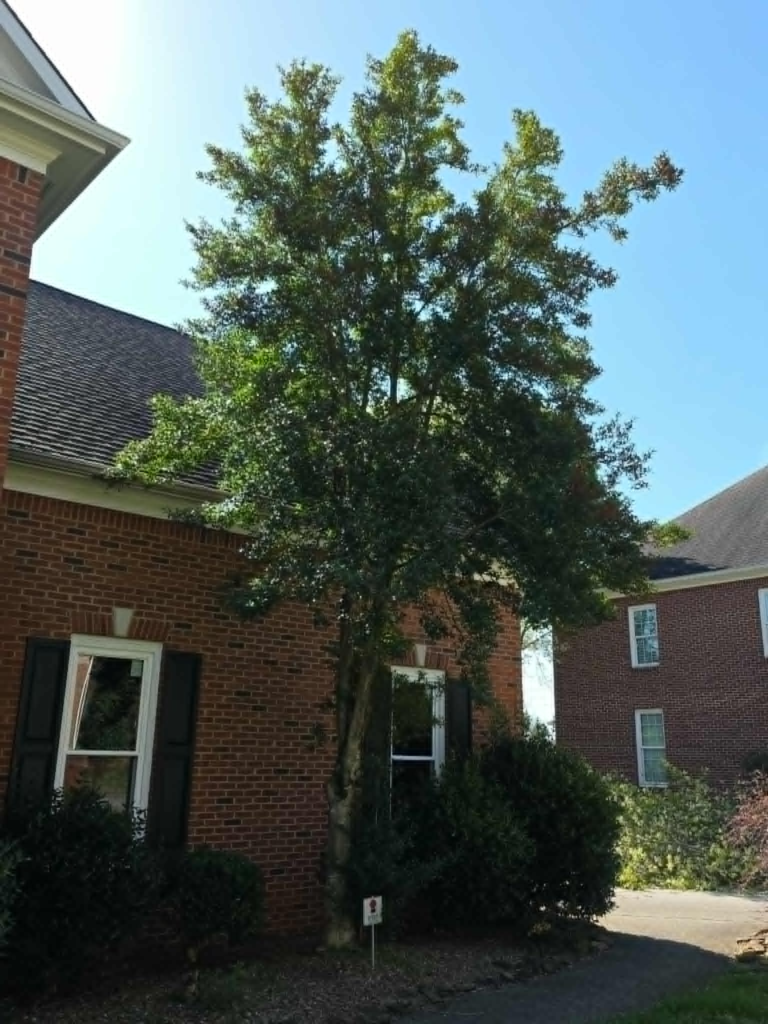
Immediate First Aid: What to Do This Week
Once you have identified the tree is stressed and worked out the likely causes, here is what to do in the next seven days. These are the interventions that give a struggling tree its best chance to stabilize.
Step 1: Water Deeply, Not Frequently
Set a soaker hose in a spiral pattern around the tree, positioned near the drip line (the outer edge of the canopy). Turn it on to a slow trickle and let it run for 45 minutes to an hour. The goal is to moisten the soil 6 to 12 inches deep, forcing roots to grow down into the moisture rather than staying shallow.
For a small tree, this might use 15 to 30 gallons of water. For a mature shade tree, 50 to 100 gallons in a single watering session is not unusual. Do this once a week during dry stretches. Skip it during rainy weeks.
Do not water every day. Shallow daily watering creates shallow root systems, which is exactly the opposite of what you want.
Step 2: Fix the Mulch
If there is a mulch volcano piled against the trunk, pull it back immediately. Get the mulch at least 3 inches away from the bark on all sides. If bark has already died from prolonged mulch contact, it will not come back, but you can stop making it worse.
Apply fresh organic mulch (shredded hardwood is ideal) in a wide donut shape, 2 to 4 inches deep, extending out toward the drip line. Keep that 3-inch clearance around the trunk. This is the 3-3-3 rule: 3 inches deep, 3 feet or more wide, 3 inches away from the trunk.
Step 3: Stop All Fertilizing
This is the counterintuitive step. When a tree looks sick, the instinct is to feed it. Do not. Fertilizer (especially high-nitrogen products) forces the tree to push out weak new growth that the compromised root system cannot support. You end up making the tree work harder while its resources are already depleted.
Hold off on all fertilizer until the tree has visibly stabilized for at least one full growing season.
Step 4: Do Not Prune Anything Living
Remove only clearly dead branches. Do not shape the tree. Do not thin the canopy. Do not clean up the tree because it looks unhealthy. Every living branch that comes off is a source of photosynthesis the tree needs to generate the energy for recovery. Pruning stressed trees is one of the fastest ways to push them over the edge.
If you must remove branches (safety hazards, obvious dead wood), keep it minimal and use clean cuts just outside the branch collar.
Step 5: Eliminate Turf Competition
Grass under the canopy competes aggressively with tree roots for water and nutrients. If you have lawn growing right up to the trunk of a stressed tree, kill the grass in a 3 to 6 foot radius (whichever fits your yard). Replace it with mulch. The tree will thank you.
Step 6: Protect the Trunk
Install a physical guard around the trunk if lawn equipment gets anywhere near it. Even a piece of corrugated drain pipe cut lengthwise and wrapped around the trunk works. The point is preventing further mechanical damage while the tree is fighting to recover.
The Recovery Roadmap: What to Do Over the Next Season
Immediate first aid stabilizes the tree. Long-term recovery requires sustained attention over the next 6 to 24 months. Here is the roadmap.
Month 1 to 3: Address the Underlying Cause
First aid buys time. Real recovery requires fixing whatever caused the stress. If the tree is compacted, plan for soil aeration. If it was planted too deep, arrange for root flare excavation. If pests are the problem, identify them accurately and treat appropriately.
This is the point where a professional tree assessment in Knoxville pays for itself. An arborist can identify problems you cannot see (root damage, internal decay, hidden pest infestations) and recommend the specific interventions that will actually help.
Month 3 to 6: Soil Repair
For compacted soil, professional air spading uses high-pressure compressed air to loosen soil around the root zone without damaging roots. It is one of the most effective interventions for trees whose decline traces back to compaction. The cost varies but typically runs $500 to $1,500 for a residential tree, depending on canopy size.
For soil that is just tired and depleted, top-dressing with compost (2 to 3 inches spread over the root zone) can add slow-release nutrients and improve soil biology without shocking the tree. Do not till it in. Just spread it on the surface and let it work down naturally.
Month 6 to 12: Monitor and Support
Keep the deep watering going during dry stretches. Maintain the mulch. Watch for new symptoms. Take photos monthly so you have a visual record of progress or continued decline. If the tree is stabilizing, you will see subtle signs: better leaf color, fewer new dead branches, more normal-looking growth.
Month 12 to 24: Reassess
After a full growing season under intensive care, you should have a clear read on whether the tree is going to make it. Trees that show visible improvement (new growth, canopy filling in, no additional decline) are winning the recovery battle. Trees that keep declining despite proper care usually cannot be saved, and it is time to plan for removal before they become hazards.
Species-Specific Recovery Notes for Knoxville Trees
Different trees respond differently to recovery efforts. Here is what to know about the most common Knoxville species.
Ash Trees (Fraxinus)
If your ash is showing top-down canopy loss in Knox County, it is almost certainly Emerald Ash Borer. Treatment with systemic insecticides can protect healthy ash trees, but once a tree has lost more than 30 percent of its canopy to EAB, treatment success drops sharply. Get professional evaluation quickly.
Red Oaks (Quercus rubra) and Pin Oaks (Quercus palustris)
Bacterial leaf scorch is common on Red Oaks in Knoxville. There is no cure, but good soil care, deep watering, and stress reduction can extend the tree’s useful life by many years. Avoid summer pruning on all oaks in Knox County due to Oak Wilt risk (April through July).
White Oaks (Quercus alba)
Generally resilient and long-lived, but sensitive to root disturbance. Most White Oak decline traces to construction damage or soil compaction over the root zone. Recovery requires reducing traffic and compaction, plus deep watering during dry stretches.
Maples (Silver, Red, Sugar)
Silver Maples decline quickly once stress sets in due to their inherently brittle wood. Red Maples are more resilient but suffer badly from heat stress. Sugar Maples are the most sensitive to soil compaction and urban stress. All maples respond well to soil aeration and mulching interventions.
Dogwoods (Cornus florida)
Notoriously susceptible to anthracnose and powdery mildew in Knoxville’s humidity. Improve airflow with selective pruning of nearby vegetation. Avoid overhead watering. Consider replacing with disease-resistant varieties (like the Appalachian series developed at UT) if disease pressure is severe.
Pines (Loblolly, Virginia)
Southern Pine Beetle can decimate stressed pines quickly. Look for popcorn-like resin masses (pitch tubes) on the trunk. Once beetles are actively boring, treatment is often too late. Prevention through stress reduction is the primary defense.
What NOT to Do (Common Mistakes That Make It Worse)
Homeowners with sick trees often reach for the wrong tools. Here is what to avoid.
Do Not Apply Fertilizer to a Stressed Tree
Every homeowner’s instinct is to feed the sick tree. Every arborist knows this makes things worse. Save the fertilizer for after the tree has recovered.
Do Not Prune Heavily to “Clean Up” the Tree
Removing living branches from a stressed tree removes photosynthetic capacity it desperately needs. Only take out clearly dead wood, and even then, keep the pruning minimal.
Do Not Water Daily
Shallow daily watering creates shallow, weak root systems. Deep, infrequent watering (once a week during dry stretches) is what actually helps.
Do Not Wrap the Trunk Tightly
Sometimes people wrap stressed trunks in burlap or tree tape, thinking it will help. It traps moisture, encourages pests, and often makes bark problems worse.
Do Not Paint or Seal Wounds
Decades of research has shown that tree paint slows healing and traps moisture that encourages rot. Clean pruning cuts at the branch collar are all a tree needs to seal its own wounds naturally.
Do Not Wait Too Long to Get Professional Help
Every month of continued decline reduces the chance of recovery. Trees that could have been saved in April sometimes cannot be saved in July. When in doubt, get an arborist opinion sooner rather than later.
When to Call an Arborist (Do Not Wait)
Some situations require professional evaluation regardless of how confident you feel about DIY recovery. Call an arborist if you see any of the following:
- More than 30 percent canopy loss.
- Any leaning that was not there before, especially toward structures.
- Large fungal conks or mushrooms on the trunk or root zone.
- Vertical cracks in the trunk that go past the bark and into the wood.
- Confirmed pest infestations (EAB exit holes, pine beetle pitch tubes, extensive borer activity).
- Continued decline after 4 to 6 months of proper care.
- Any tree of significant size (over 30 feet) that could damage structures if it fails.
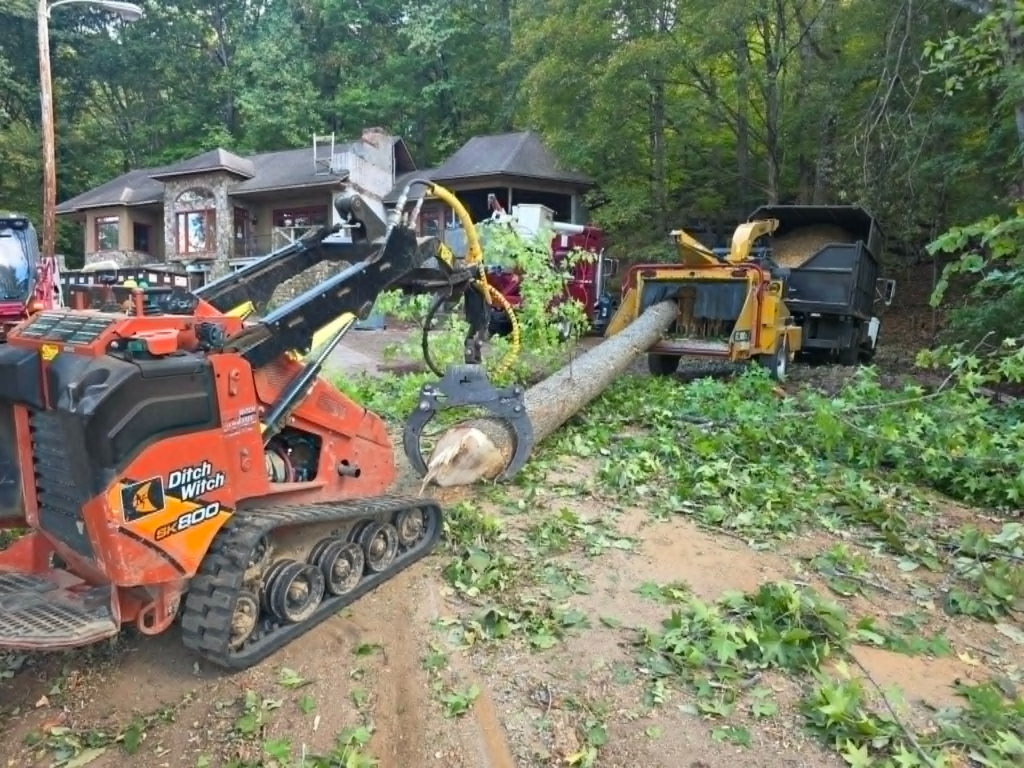
If the tree is past the point of recovery, the responsible move is planned tree removal in Knoxville TN before it becomes a hazard. A dead tree brought down under controlled conditions costs a fraction of one that fails during a storm and takes something else with it.
How Long Recovery Actually Takes
Realistic expectations matter. Trees do not bounce back overnight. Here is the timeline for what recovery actually looks like.
- Weeks 1 to 4: Immediate stabilization. No obvious visible improvement, but the tree stops actively getting worse.
- Months 2 to 6: If interventions are working, you should see slight canopy fill-in, better leaf color, and no new dead branches.
- Months 6 to 12: First growing season under care. Clearer signs of recovery: normal spring leaf-out, improved canopy density, possibly some new growth from previously bare branches.
- Years 2 to 3: Continued visible improvement. Canopy fills in further. Deadwood in the interior may need light pruning as new growth replaces it.
- Years 3 to 5: Full recovery for trees that were going to make it. At this point, the tree is functioning normally and should be resilient to future stress events.
Trees that have not shown visible improvement by the end of the first full growing season under care usually will not recover. That is a hard call to make, but a professional assessment can confirm it.
Frequently Asked Questions
Can a dying tree really be saved?
Sometimes. If the tree still has green cambium tissue in the trunk (verify with the scratch test), if the underlying cause of stress can be identified and addressed, and if you act quickly enough, many stressed trees recover fully. Trees with dead trunks, hollow interiors, or more than 50 percent canopy loss are usually beyond saving.
How much water does a stressed tree actually need?
Deep watering once a week during dry stretches, with enough water to moisten the soil 6 to 12 inches deep. For a mature tree, this typically means 50 to 100 gallons in a single session. Skip watering during weeks with adequate rainfall.
Should I fertilize a stressed tree?
No. Fertilizer forces new growth that a compromised root system cannot support, worsening the stress. Wait until the tree has recovered for a full growing season before considering fertilizer, and even then, only if a soil test shows a specific deficiency.
What is the biggest mistake homeowners make with sick trees?
Applying fertilizer, especially high-nitrogen products. Second biggest is over-pruning to “clean up” the tree, which removes photosynthetic capacity the tree needs to recover.
How do I know if my tree is stressed or just going through normal seasonal changes?
Timing is the biggest clue. Normal fall color and leaf drop happen in October and November. Leaves changing color or dropping in July and August are almost always a stress signal. Persistent wilting in the morning is another key sign, since normal seasonal wilting only happens in hot afternoons.
Can I save a tree that was hit by lightning?
Sometimes. Lightning damage can be superficial (a strip of bark peeled off) or catastrophic (internal wood exploded). Superficial damage often heals with time and good care. Catastrophic damage usually results in tree death within 1 to 3 years. Have an arborist evaluate the extent of the damage.
How much does professional tree recovery work cost in Knoxville?
Written risk assessments run $200 to $600. Air spading for soil compaction runs $500 to $1,500 for a residential tree. Root collar excavations run $200 to $500. Ongoing plant health care programs run $300 to $1,000 per year depending on tree count and treatment complexity.
What if the tree is close to my house and I am not sure if it is safe?
Get a professional assessment immediately. Do not wait. A tree that is both stressed and near a structure is a liability question, not just a horticultural one. An arborist can evaluate whether the tree can be safely rehabilitated or whether removal is the more responsible option.
Can I recover from tree stress on my own without hiring anyone?
For minor stress on small trees, often yes. For serious decline on mature trees, or for any situation where the underlying cause is not obvious, professional help dramatically improves the odds. An initial assessment is inexpensive compared to the cost of losing a mature tree unnecessarily.
Your Tree Recovery Action Plan
Here is the whole plan in one place. Save this. Print it. Refer back to it as you work through the process:
- Perform the scratch test to confirm the tree is still alive.
- Walk the property and take photos of every symptom for reference.
- Identify the likely cause: drought, root damage, compaction, mulch problems, pests, or something else.
- Fix the mulch: 3 inches deep, 3 feet wide, 3 inches away from trunk.
- Set up deep watering with a soaker hose. Once a week during dry stretches.
- Stop all fertilizing. No exceptions.
- Do not prune living branches. Remove only confirmed dead wood.
- Kill any turf competition in a 3 to 6 foot radius around the trunk.
- Install trunk guards to prevent further lawn equipment damage.
- If the underlying cause is not obvious or the tree keeps declining, get a professional assessment.
- Monitor monthly. Take photos. Track progress or continued decline.
- After one full growing season, reassess. Recovering trees show visible improvement. Trees that are not going to make it will keep declining.
If you are dealing with a stressed tree and want an honest evaluation, our team offers free property walkthroughs across the Knoxville tree service area including Knox County, Loudon County, Blount County, Lenoir City, Maryville, and Farragut. We will look at the tree, tell you what we see, and give you our real opinion on whether it can be saved. If it can, we will help you save it. If it cannot, we will help you plan a safe removal.
Call us at (423) 519-7484 or visit our contact page to schedule. A tree in decline does not have a lot of time to spare. The sooner you know what you are dealing with, the more options you have.