Tree Removal Near a Septic Tank or Drain Field: What Homeowners Should Disclose Before Work Begins
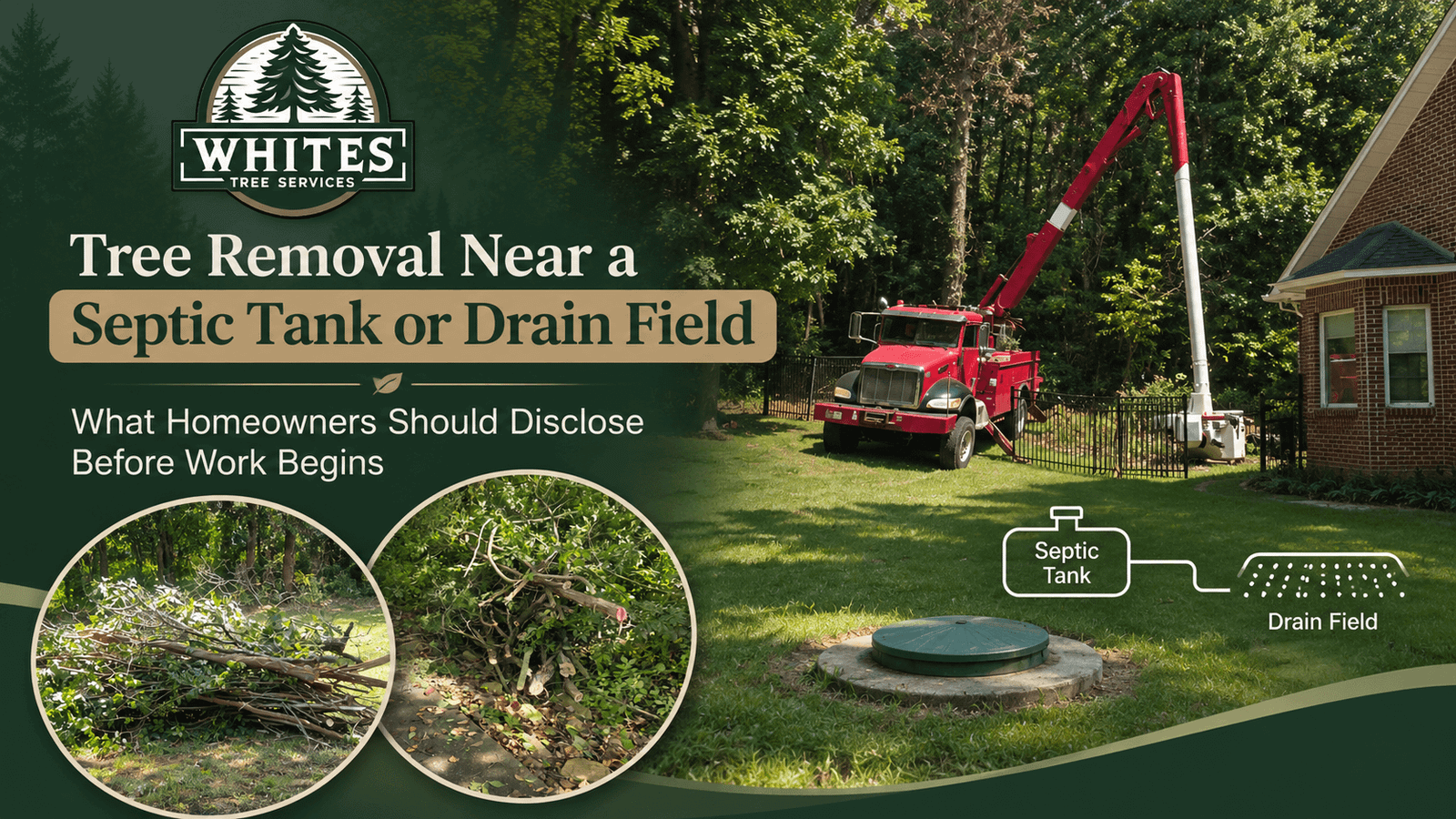
Planning tree removal near septic tank and drain field areas starts with one honest conversation. Before anyone prices the job, the crew needs to know what is buried around the tree, not just what is growing above it. Here is what to share, and why each detail matters.
Maybe a big oak is leaning toward the house, and you know the septic tank sits somewhere in the backyard. Or the tree is nowhere near the tank lid, but the only way to reach it runs across the side yard where you think the drain field is. Either way, the tree is only one part of the decision. The trunk, the stump, the path equipment takes to get there, and the places where logs and brush get set down all have to fit around a system you can’t see.
Septic systems come with the territory for anyone offering local tree services in Knoxville and Lenoir City, since so many homes in Knox County and the surrounding communities sit outside the city sewer network. We would much rather hear about yours during the estimate than discover it on the morning of the job.
By the end of this guide, you’ll know:
- What septic information to share before the estimate, even if your records are incomplete.
- Which access and equipment questions to ask, so trucks, wood, and machines stay off the parts of the system that can’t take the weight.
- When stump grinding or a septic professional needs to enter the conversation, and why those decisions are separate from cutting the tree down.
Those details shape how we carry out tree removal services for residential properties, from where the truck parks to whether the stump gets ground at all.
Why Septic System Location Matters Before Tree Removal
Most homeowners picture a septic system as the round lid or the slightly raised patch of grass in the yard. That lid is only one piece. The tank, the outlet pipe, the distribution box, the drain field, and the connecting lines can each sit in a different part of the property, and grass grows evenly over all of them. Without records or professional help, there’s usually no reliable way to tell where one component ends and the next begins.
Because of that, a tree can stand well away from the tank and still have a work zone that overlaps another part of the system. So our first piece of advice is simple: share what you know about your septic system even if you’re confident the tree isn’t directly above it. A detail that seems unrelated to you may change how the whole job is laid out.
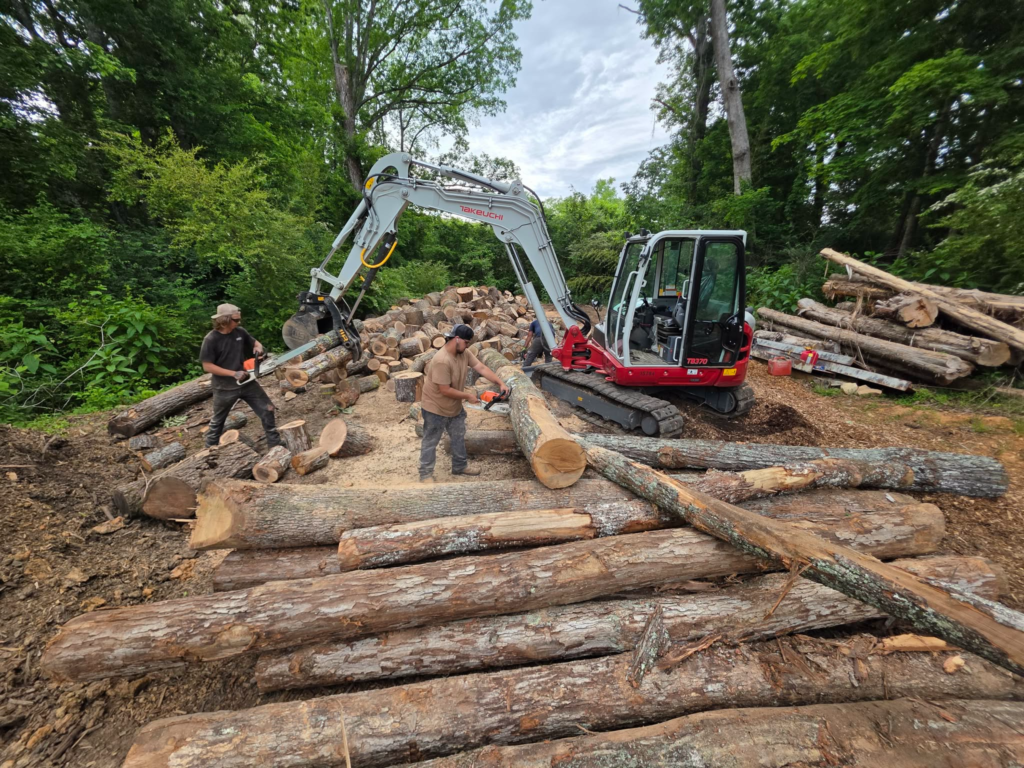
Understand the Different Parts of a Septic System
You don’t need to be a septic expert to have a useful conversation with a tree crew. Knowing the basic parts helps you describe your property and spot where the risks might be.
- Septic tank. A buried, watertight container that receives wastewater from the house. Solids settle to the bottom, lighter material floats, and the partly treated liquid moves on.
- Outlet pipe. The pipe that carries liquid out of the tank toward the next part of the system.
- Distribution box. In systems that have one, this small buried box divides the flow so wastewater spreads evenly among the drain-field lines.
- Drain field. Also called a leach field, absorption field, or soil treatment area, this is the section of soil where wastewater soaks in and receives further treatment. It’s usually a set of buried trenches holding pipe or chambers.
- Private connecting lines. The buried pipes linking the house, the tank, and the other components. These belong to the homeowner, not to a public utility.
Some properties also have extra pieces, such as a pump tank or an alternative treatment unit. If your system includes anything beyond a basic tank and field, that’s worth mentioning too.
Why the Tree’s Location Is Only Part of the Picture
When we look at a tree near a septic system, several separate questions come up at once:
- The trunk: where the tree actually stands relative to the tank, pipes, and field.
- The stump: what happens to it after the tree comes down, which matters far more if grinding is planned.
- The canopy and roots: how far the limbs reach overhead and how far roots likely spread underground.
- The landing zone: where sections of wood will land or be lowered to the ground.
- The access route: how people, equipment, and debris move to and from the tree.
The landing zone deserves a closer look. A heavy log dropped onto a shallow tank lid, a riser, or a distribution box can crack it. That’s one reason a crew may choose to take a tree down in sections and lower the pieces with ropes rather than felling it whole toward the system. The right method depends on the tree and the site, and it can only be chosen well when the crew knows where the vulnerable spots are.
What Homeowners Should Tell the Tree Removal Company
This is the practical heart of the guide. The more of this you can share when you ask for an estimate, the more accurately the job can be planned and priced. If you don’t know something, say so. “I’m not sure” is far more helpful than a confident guess.
1. Whether You Have a Septic System Layout Map
The best starting point is any document showing where your system was installed. Look for:
- A septic layout or installation drawing
- Septic permit or inspection records
- A property survey or site plan that shows septic components
- Paperwork from past pumping, service, or repair visits
- Notes or sketches marking the tank, drain field, or private lines
Many of these turn up in the closing documents from when you bought the home. Even a rough sketch with measurements from the house can make a real difference.
If you don’t have a map, tell us that as well. Please don’t try to work out the boundaries yourself by digging, probing the ground, or lifting the tank cover. Later in this guide, we explain what to do instead.
2. Whether You Know the Tank Location and Type
Next, share what you know about the tank itself:
- Where you believe the tank is located
- Whether it has a visible access lid, riser, or inspection port
- Whether that lid or riser sits at the surface or just below it
- Whether the tank is concrete, plastic, fiberglass, or unknown
- Whether a septic professional confirmed the location or it’s a best guess
Tank material helps you describe your system, but it doesn’t tell anyone how much weight the tank can handle. A concrete tank shouldn’t be treated as something equipment can roll across, and neither should a plastic or fiberglass one. No responsible contractor should read tank material as permission to drive over it.
3. Where the Drain Field and Private Lines Are Located
The drain field usually covers more ground than the tank, which makes it the part of the system most likely to overlap a work area. If you know them, share:
- The approximate boundaries of the drain field
- The direction the pipe runs as it leaves the tank
- Where the distribution box sits
- Known private septic lines, including the line from the house to the tank
- Additional components, such as a pump tank or treatment unit
- Any area reserved for a future replacement drain field
That last item is easy to forget. Tennessee septic permits can show ground set aside for a duplicate system alongside the original one, and compacting that space now could make it harder to use later. If your permit shows a reserve area, treat it with the same care as the working field.
It also helps to mention what you know about the pipes themselves: roughly how old the system is, whether the lines are older clay or cast iron or newer plastic, and whether any are known to run shallow.
Approximate locations are genuinely useful. A comment like “the field runs along the left side of the backyard toward the fence” can shape how a crew approaches the whole project. Still, a rough location isn’t a substitute for professional confirmation when there’s real uncertainty and the work will happen close by.
4. The Tree’s Approximate Size, Species, and Location
Then tell us about the tree:
- Approximate height or trunk size, if you know it
- The species, if you know it
- Roughly how far the tree stands from the tank
- Roughly how far it stands from the suspected drain field
- Whether the trunk appears to sit directly above or close to a septic component
- Any visible roots, exposed pipes, sunken spots, or past damage nearby
Rough estimates are fine. Photos from a few angles are even better, especially ones showing the tree, the tank lid, and the path into the backyard. This information helps us understand the job before we walk the property and put together an accurate estimate.
Species tells us something about how roots typically behave, but it doesn’t decide on its own whether a removal can be done safely. That depends on the full picture.
5. Whether You Want the Stump Ground or Left Cut Flush
Taking a tree down above ground and grinding the stump below ground are two different scopes of work, and on a septic property, that difference matters. Let us know up front whether you want the stump ground or simply cut flush. A tree that can be removed safely doesn’t automatically mean its stump can be ground safely in the same spot, so we cover this decision in its own section below.
6. Whether the Septic System Has Existing Problems
Mention anything you’ve noticed about how the system has been working:
- Previous septic repairs
- Root intrusion or root-related backups in the past
- Drainage problems in the yard
- Standing water or soggy areas
- Sewage odors inside or outside the house
- Slow drains or backups
- Damaged tank lids or exposed components
These details matter for two reasons. Soft or soggy ground changes how and where equipment can work. And if there are signs of an active septic problem, a septic professional should look at the affected area before tree work is planned around it. Taking out a tree near a struggling system won’t fix the system, so it helps to know where things stand first.
7. Other Private Lines Near the Work Area
A septic system is rarely the only thing buried in a backyard. If any of these run near the tree, the stump, or the access path, include them:
- Well lines
- Irrigation systems
- Wiring for landscape lighting or power to a detached garage, barn, or pool equipment
- Invisible pet fences
- Propane lines, including connections for outdoor grills
Like the septic system, these belong to you rather than a utility company, which affects whether anyone will mark them before work begins. We explain why in the section on utility locates.
How Equipment Access Can Affect Tree Removal Near a Septic Field
Homeowners naturally focus on the tree. A crew has to think about everything between the street and the tree as well, and on a septic property, that stretch of yard is where many of the real decisions get made.
The Work Area Is Larger Than the Tree’s Footprint
A removal plan covers much more than the spot where the trunk stands. Depending on the job, the crew may need to work out:
- Where trucks and equipment can park
- How equipment will reach the tree
- Whether a narrow gate, fence, slope, or tight side yard limits access
- Where branches and logs will be staged during the work
- How debris will travel out to the chipper or truck
- Whether any part of that route crosses a known or suspected septic area

Sloped lots and tight side yards are common around Knoxville, and they can narrow the options for reaching a backyard tree. Sometimes the only flat, open path runs straight across the drain field. A tree at the far edge of the yard can look like a simple removal until the access route turns out to be the main planning concern.
Ground conditions play a part too. Clay-heavy soil is common across East Tennessee and can stay soft well after a storm, and soft ground ruts and compacts more easily. A route that would be fine in a dry spell may not be fine the week after heavy rain.
Why Heavy Equipment Should Stay Off the Drain Field
A drain field works because water can move freely through the soil beneath it. Anything that presses that soil together interferes with the job it was built to do.
The EPA points out that most drain fields are built in open lawn areas and aren’t designed to carry vehicles or heavy equipment, and that the weight compacts the soil and can damage pipes. The Tennessee Department of Health puts it even more simply: don’t drive or park over any part of a septic system.
In practical terms:
- Heavy vehicles and equipment can compact the soil over the field.
- Compacted soil can reduce the field’s ability to absorb and treat wastewater.
- Weight can crack or crush buried pipes, the distribution box, and other components.
- The drain field should never serve as a parking spot, staging area, or shortcut.
That last point applies to wood as much as machines. Heavy hardwood rounds stacked on the field for an afternoon still put real weight on it.
What Should Be Discussed About Ground Protection?
Ground protection is a fair topic to raise, but the best starting question isn’t “what can we put down so equipment can cross the field?” It’s “how do we avoid crossing the field at all?”
Questions worth settling with your contractor include:
- Can the equipment route avoid the known septic area entirely?
- Is there another way in, such as a different gate, the opposite side yard, or a neighbor’s driveway used with permission?
- Where can equipment, logs, and brush be staged away from the system?
- Is the ground soft or wet right now?
- Would a different removal approach, such as more rope work and carrying debris by hand, cut down on ground traffic?
- Can the written estimate note the no-drive areas and the stump decision?
Mats and plywood do a good job of spreading equipment weight across an ordinary lawn, which is why site assessment and ground-protection planning usually go hand in hand on a removal.
Ground protection is not permission to drive over a drain field, though. A mat spreads weight. It doesn’t turn a septic system into something rated for equipment. If the field truly can’t be avoided, that’s the signal to pause and talk through other options rather than push ahead.
Does a Public Utility Locate Identify Private Septic Lines?
Many homeowners assume that once the utility flags are in the yard, everything underground has been accounted for. On a septic property, that assumption can cause real problems.
Tennessee 811 is the state’s one-call center. When someone submits a locate request, Tennessee 811 notifies its member utilities, and those utilities or their contract locators mark the lines they own or maintain. Tennessee 811 doesn’t mark lines itself, and not every utility is a member.
For septic owners, the key issue is ownership. Tennessee 811 lists lines to septic systems among the private facilities on a property, and it explains that utility operators didn’t install those lines and can’t locate them. A septic tank, drain field, distribution box, and homeowner-owned connecting lines should not be assumed to be included in a standard Tennessee 811 locate. KUB has made the same point locally, noting that customer-owned service lines for water and wastewater may not be marked.
What that means for your project:
- Tell your tree contractor about the septic system directly, even if a locate request has already been made.
- Use septic records or a septic professional to establish where the system is, when needed.
- Don’t treat utility paint or flags as proof that the septic area is clear.
What About Tree Roots Near Septic Tanks and Drain Fields?
Root worries are often what get a homeowner thinking about removal in the first place, so they deserve a straight answer.
Tree roots grow toward water and nutrients, and a septic system, especially the drain field, offers both. Roots can work their way into pipes that are cracked, have loose joints, or are otherwise vulnerable. Once inside, they can slow or block the flow of wastewater.
How much of a concern that is depends on several things together: the type and size of the tree, the design and condition of the system, the soil, and how close the roots are to the pipes. A large tree near the field isn’t a guarantee of damage, and a small one isn’t a guarantee of safety.
One point is worth stating plainly: taking a tree down doesn’t repair septic damage that has already happened. Roots that are already inside a line stay there after the tree is gone, and the line still needs attention from a septic professional. If you’ve seen root problems or heard a septic company mention root intrusion, include that when you contact us.
What Trees Should Be Avoided Near Septic Systems?
Trees and shrubs with extensive, moisture-seeking root systems are commonly discouraged near septic components, and especially near drain-field pipes. The EPA does not recommend planting trees or shrubs on the drain field because their roots can damage the pipes. The Tennessee Department of Health goes further, advising against planting anything over the soil treatment area other than non-irrigated native grasses.
Willows are the example most people hear about, since they’re known for aggressive roots that go looking for water. That reputation is a reason for caution, not proof that a particular willow has damaged a particular system. The same goes for any species, because site conditions matter as much as the tree.
If you’re planning to replace a tree you’re removing, ask a septic professional where new plantings can safely go before you pick a spot.
How Close Can a Tree Be to a Septic Drain Field?
There’s no single distance that fits every property. You’ll find numbers online, but the right spacing depends on the septic design, the species and mature size of the tree, the soil, and the layout of the site.
As a tree company, we can tell you a lot about the tree. Questions about how close a tree can safely grow to your specific system belong with a septic professional or the local office that permits septic systems.
Should You Grind a Stump Near a Septic Tank or Drain Field?
Stump grinding near a septic field gets its own section because it’s a different kind of work from cutting the tree down.
Removal happens above ground. Grinding works below the visible surface, cutting through the stump and the top of the root flare. That puts the work into the same layer of soil where private septic lines and components may be running. <!– IMAGE 4: stump-grinding-near-septic-system.jpg | Alt: Stump grinding considerations near underground septic components –>
Before grinding is approved, a few questions need clear answers:
- Where is the stump in relation to the system? A stump directly over or close to the tank, a line, or the drain field needs further evaluation before anyone grinds it.
- Have roots grown into a nearby pipe? Grinding, digging, or pulling a stump whose roots are tangled in a line can disturb that line.
- What result do you actually want? Some homeowners want the stump gone so they can mow over the spot. Others are happy with a flush cut. Tell us which before we price the job.
- Can the grinder reach the stump without crossing the field? The access question applies here just as much as it does to the removal.
If the layout around the stump is uncertain, confirm it first. In some cases, leaving the stump cut flush, or grinding it less deeply, is the more sensible choice until the system is mapped. We’d much rather talk that through honestly than promise grinding that isn’t right for the spot.
Questions to Ask Before Scheduling Tree Removal Near a Septic System
Before you approve an estimate, these questions help make sure you and your contractor are working from the same picture:
- Have we identified where the septic tank and drain field are?
- Do you need a copy of my septic layout or inspection records?
- Does the planned equipment route pass near any known septic components?
- Where will trucks, equipment, logs, and branches be staged?
- How will the crew avoid unnecessary traffic over the drain field?
- Is stump grinding included, or is it a separate part of the estimate?
- Does the stump’s location call for more septic-system evaluation?
- Will the written estimate note the no-drive areas and the stump plan?
- Should I contact a septic professional before the work is scheduled?
Not every job calls for the same equipment or the same approach. The point of these questions is clear communication, so the plan you approve is the plan the crew carries out.
What If You Do Not Know Where Your Septic System Is Located?
Plenty of homeowners don’t, especially in older homes or properties that have changed hands a few times. Here’s a practical way to sort it out:
- Check your closing documents. Paperwork from the purchase sometimes includes septic permits, inspection reports, or a site plan.
- Look for other records. Pumping receipts, repair invoices, and inspection reports often note where the tank sits.
- Ask the permitting office what’s on file. Depending on the county and when the system went in, a Tennessee septic permit may have been issued by TDEC or by a county health department, and older systems sometimes have limited records. Around Knoxville, TDEC’s Knoxville Environmental Field Office takes septic questions, and TDEC’s online septic records search is a useful first stop. Don’t be surprised if it doesn’t show everything; a phone call can fill the gaps.
- Bring in a septic professional. If the layout is still unclear, a septic inspector or installer can locate and mark the system, which is the same advice Penn State Extension gives homeowners whose records fall short.
- Share what you learn. Send the records, photos, or markings to your tree contractor before the work is scheduled.
What you shouldn’t do is go hunting with a shovel or a probe rod. Digging can damage pipes, and opening a tank yourself is genuinely dangerous. Septic tanks can hold toxic and flammable gases, and the lids are heavy. Tank work belongs with trained professionals.
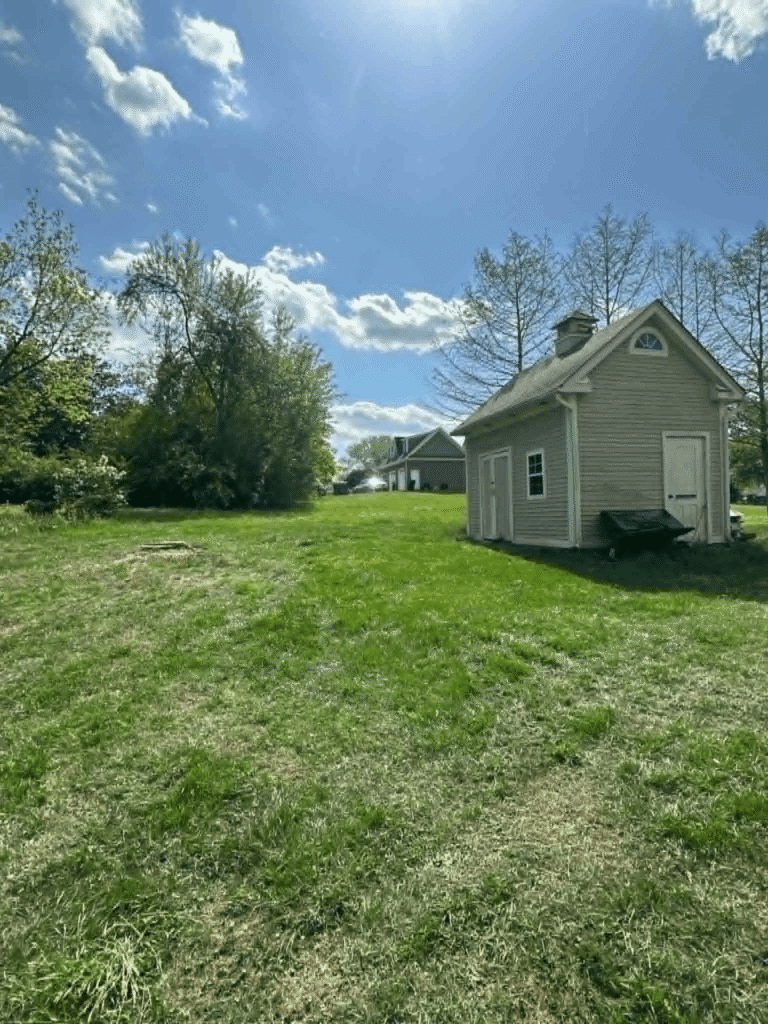
Prepare Your Property Before Requesting a Tree Removal Estimate
You don’t need every technical detail sorted out before you call a tree removal company. You just need to share what you know and be upfront about what you don’t. Before you reach out, try to pull together the following:
- Any septic layout drawings, permits, or property records you can find
- The approximate tank and drain-field locations, if known
- Whether the tank is concrete, plastic, fiberglass, or unknown
- Any known private septic lines, other buried lines, or extra system components
- The tree’s rough size and its distance from the septic area
- Your decision on stump grinding versus removal above ground only
- Any existing septic problems or recent repairs
- Photos showing the tree, the tank lid, and the likely access path
When you’re ready to request an on-site tree removal estimate, the message box on the form is the best place for these details. A few lines are plenty. Something like this gives us a head start before we visit:
“Large oak in the backyard, roughly 30 feet from the tank lid. The drain field runs along the left fence. I have the original septic permit drawing and can send photos. I’d like the stump ground if it makes sense for the spot.”
Seeing the tree, the system, and the access route in person lets us give you a realistic plan and price instead of a guess.
Frequently Asked Questions
Can you remove a tree near a septic tank?
Yes, in many cases. The tank, the connecting lines, the drain field, and the equipment route all need to be considered before work begins. The exact plan depends on where the tree stands, what you want done with the stump, and what is known about the septic layout.
How close can a tree be to a septic drain field?
There’s no universal distance. It depends on the tree, the soil, and how the system was designed, so ask a septic professional or your local permitting office for advice specific to your property.
What trees are bad for septic systems?
Trees and shrubs with extensive, aggressive root systems can cause problems near septic pipes and drain fields. Willows are the most commonly cited example. The right planting distance depends on the specific system and site, so check with a septic professional before planting.
Can tree roots damage septic lines?
Yes. Roots can enter cracked or vulnerable pipes and slow or block the flow of wastewater. Removing the tree won’t clear roots already inside a line, so if you suspect root intrusion, have a septic professional evaluate the system.
Can you grind a tree stump near a septic field?
Sometimes. Grinding works below the surface, so the location of nearby septic components should be known before it’s approved. Until then, a flush cut is often the safer choice.
Can heavy equipment drive over a septic drain field?
It shouldn’t. State and federal septic guidance both advise against driving or parking over a septic system, so the better plan is a route that avoids the field entirely.
Plan Tree Removal Around Your Property’s Septic System
A smooth removal on a septic property comes down to what the crew knows before it arrives. Share what you know about the system and the tree, be upfront about what you don’t, and settle the stump question early. Those three habits prevent most surprises on the day of the job.
At Whites Tree Services, every job is owner-operated by Chris White and his crew, and we never subcontract. We’ll walk the property with you, look at the tree and the access route together, and talk through the septic details before anything is scheduled. If you have a tree near your septic system anywhere in the Knoxville or Lenoir City area, give us a call at (423) 519-7484 or reach out online to get started.
Let’s plan your removal around what’s underground. Share your tree and septic details, and we’ll set up an on-site visit. Button: Schedule Your Free Estimate →