How to Choose a Tree Service Company in Knoxville: A Homeowner’s Complete Guide
Hiring the wrong tree service in Knoxville can cost you far more than the price of the job. Uninsured crews leave you liable for accidents on your property. Amateur removals crush fences, gutters, and roofs. Improper pruning ruins mature trees that took decades to grow. And storm-chasing contractors vanish with your deposit before the first branch hits the ground.
The stakes are real, but they’re also manageable. Any Knoxville homeowner willing to spend an hour vetting tree companies before signing a contract can avoid the vast majority of bad outcomes. This guide walks through everything worth checking, in the order that matters, with specific attention to the credentials, questions, and red flags that apply here in Knox County.
Whether you need a hazard tree removed before the next storm, a mature oak trimmed properly, or an emergency response after high winds, the criteria for choosing a tree service company in Knoxville stay the same. What changes is how much weight to put on each item based on your specific job.
Quick Checklist: 10 Things to Verify Before Hiring Any Tree Service
For homeowners who want the short version, here’s what to confirm before signing any tree service contract in Knoxville:
- Current general liability insurance with a certificate sent directly from the insurer
- Workers’ compensation coverage verified through the same certificate
- Registration with the City of Knoxville Tree Maintenance Registry (Section 14-39, for work inside city limits)
- A written, itemized estimate with scope, cleanup, and total clearly stated
- Positive, recent Google My Business reviews with a consistent pattern of praise
- A verifiable local address and phone number for a real physical presence
- Local experience with East Tennessee tree species and storm patterns
- The right equipment for your specific job (bucket truck, crane, stump grinder as needed)
- A clear cleanup and debris-removal plan included in the price
- Reasonable payment terms with no demand for full payment upfront
Any tree service company in Knoxville that clears these ten items is worth taking seriously. Any that struggles with even a few of them is probably worth passing on.
The rest of this guide covers each item in detail, plus the Knoxville-specific factors most homeowners don’t know to ask about.
Why Choosing the Right Tree Service Company Matters
Tree work is one of the most dangerous services performed on residential properties in the United States. Fatality rates in the industry rank consistently among the highest of any occupation. Chainsaws, chippers, and climbing systems combine with heavy weight overhead and unpredictable wood behavior to make even routine removals genuinely hazardous.
Every one of those risks becomes yours the moment you hire the wrong company.
If a limb falls the wrong way, your roof, your fence, your car, or your neighbor’s property takes the damage, and responsibility for paying to repair it lands on whoever’s insurance covers the job. If a worker gets hurt on your property and the company carries no workers’ compensation, you can be held liable for medical bills. If a company demands full payment before starting and then disappears mid-job, you’re out the money and stuck with the mess.
Beyond safety, choosing well matters for the trees themselves. Improper pruning, especially topping, weakens trees permanently, invites decay and pests, and often kills mature specimens over the following few years. A single bad pruning decision on a mature oak that anchors your front yard can undo forty years of growth.
Good tree service companies operate with the training, insurance, and equipment to protect all three: your property, the people on your job, and the long-term health of the trees that remain standing after the work is done.
Step 1: Verify Insurance Before Anything Else
Insurance is the non-negotiable starting point. Skip this check and every other item on the list matters less.
A legitimate tree service in Knoxville carries two separate policies:
General liability insurance protects your property if something goes wrong during the job. A dropped limb that damages your roof, a rigging line that snaps and cracks a driveway, a chip truck that dents your garage door: all of these are covered under general liability. The industry standard for residential tree work is one to two million dollars in general liability coverage, and any established company should carry at minimum a one million dollar policy.
Workers’ compensation insurance covers the crew if a worker is injured on your property. Tree work is high-risk, and injuries do happen. Without workers’ comp, an injured worker’s medical bills and lost wages can become a claim against the property owner. This is exactly the scenario that turns a routine tree removal into a five-figure legal headache.
Tennessee requires workers’ comp once a business has five or more employees, which means smaller crews may not carry it by default. Confirm coverage before hiring regardless of crew size.
How to Verify Insurance the Right Way
The most common insurance mistake homeowners make is accepting a photocopy of an insurance certificate that the tree company hands them. Photocopies can be altered, policies can lapse without the certificate being updated, and a paper document tells you almost nothing about whether coverage is actually in force on the day of your job.
The right approach:
- Ask for a Certificate of Insurance (COI)
- Request that the certificate be emailed directly from the company’s insurance agent, not from the tree company
- Ask that your name and property address be listed as certificate holder
- Verify the policy is active as of your scheduled job date
- Confirm the coverage explicitly includes tree service work
Any reputable Knoxville tree care company will handle this request without hesitation, usually within one business day. A company that pushes back, delays, or offers excuses is telling you what to expect if something goes wrong on the job.
Step 2: Check Credentials, Registrations, and Industry Standards
Once insurance is confirmed, look at how the company demonstrates its qualifications. Different credentials matter for different kinds of work, and the right combination depends on what you need done.
Registration With the City of Knoxville
For any tree work inside the Knoxville city limits, Section 14-39 of the Knoxville Code of Ordinances requires that any individual or company performing tree work for hire on trees over twelve inches in diameter register with the city’s Urban Forester. This is the City of Knoxville Tree Maintenance Registry. It’s free, and it’s enforced against the tree company rather than the property owner, but it’s a meaningful signal.
Companies not on the registry may face stop-work orders, and the ordinance specifically notes that failure to correct a registry violation results in fines against the company. A tree service that hasn’t cleared this low bar is telling you something about how it runs its business generally. If you’re not sure how permits apply to your specific job, our Knoxville tree removal permit guide walks through the full permit and registry framework.
ANSI A300 Pruning Standards
The American National Standards Institute maintains ANSI A300 as the recognized industry standard for tree pruning, trimming, and maintenance work in the United States. Legitimate tree service companies follow these standards for all pruning work. Companies that don’t follow ANSI A300, or that can’t explain the standards when asked, are likely doing damage rather than care.
The clearest ANSI A300 red flag is any company that recommends topping as routine maintenance. Topping (cutting the top off a tree to reduce its height) is explicitly discouraged by ANSI A300 and by every recognized professional arboriculture body. It weakens trees, invites decay, creates hazardous regrowth, and often kills the tree over the following seasons. Our tree trimming vs pruning guide covers the standards in more detail.
ISA Credentials and Advanced Qualifications
For homeowners who want extra assurance on complex jobs (mature tree health assessments, structural risk evaluation, or high-value specimens where the wrong call carries big consequences), some companies employ professionals with credentials from the International Society of Arboriculture (ISA). ISA credentials are verifiable through the ISA’s directory at treesaregood.org.
Not every tree service employs ISA-credentialed professionals, and not every job needs one. For routine removals of dead or damaged trees, standard pruning of healthy specimens, and typical hedge and yard maintenance, ISA credentials are a bonus rather than a requirement. What matters more for most residential work is real local experience, proper insurance, ANSI A300 compliance, and a track record of jobs done cleanly. For complicated health or hazard questions on a valuable tree, a formal tree assessment is often the right first step regardless of who eventually does the work.
Local Business Licensing
The company should hold an active business license appropriate to its location. Larger construction-adjacent projects may require additional Tennessee contractor licensing (typically for projects over $25,000), but for standard residential tree work, a valid business license plus the city registry is the baseline.
Step 3: Get Detailed Written Estimates (Never Accept Verbal Quotes)
A real estimate is a written document that identifies exactly what you’re paying for. A verbal number shouted from the truck window is not an estimate. It’s a starting point for arguments after the job is done.
Get detailed quotes in writing from at least two, ideally three, tree service companies for any significant job. That gives you a real basis for comparison and a paper trail if anything gets disputed later.
What Every Written Estimate Should Include
A proper written tree service estimate identifies:
- The specific tree or trees being worked on, with location described (front yard tulip poplar, back-fence Leyland cypress, etc.)
- The scope of work per tree: removal to ground level, pruning, cabling, or health treatment
- Whether stump grinding is included as part of the price or listed as a separate line item
- How debris is handled: chipped and hauled, logs cut to firewood length and staged, chips left on-site as mulch
- Any permit, utility coordination, or KUB work included in the price
- Ground protection provisions for lawns, driveways, or sensitive landscape features
- Total price with payment schedule, and how any change orders would be documented
- Timeline and expected crew size
If any of these are missing from the written estimate, ask for them before signing. Any tree service worth hiring will add the detail without argument.
Why Comparing Cheapest Bids Is a Bad Strategy
The cheapest bid is often the most expensive choice by the time the job is done. Very low prices in the tree service industry typically mean one or more of the following:
- No workers’ compensation coverage (the largest cost most tree companies carry)
- No liability insurance, or an underpowered policy that doesn’t cover real property damage
- No proper equipment, meaning damage to your lawn from wrong-sized machinery
- No cleanup included, so you pay separately to haul debris after the crew leaves
- No stump grinding, invisible until the estimate reads “removal only”
- Storm-chasing contractors with no local roots and no accountability after the job
A comprehensive breakdown of what actually drives tree work pricing in Knoxville is available in our tree removal cost guide for Knox County, which explains why bids vary so widely and what a fair Knoxville-area price actually looks like for common jobs.
Step 4: Look at Local Experience and How Long the Company Has Been in Business
How long the company has been doing tree service in East Tennessee matters more than most homeowners realize. Local longevity signals financial stability, community reputation, and hands-on knowledge of the specific conditions that shape tree work in Knox County.
A tree service that has been operating in the Knoxville area for years knows things a national chain or a fly-by-night operator can’t:
- Which native and common landscape species (red oak, tulip poplar, white pine, Leyland cypress, sugar maple, hickory) behave which way under our specific weather patterns
- How local red clay soil holds and releases water, which affects both root plate stability and equipment access after rain
- Which neighborhoods have narrow gate access, sloped lots, or septic considerations that change the equipment plan
- How KUB coordinates line-clearance work in the area, and which crews communicate well with the utility
- What kinds of storm damage typical East Tennessee weather actually produces, from summer microburst wind damage to ice loading on evergreens
Ask any tree service company in Knoxville how long they’ve been operating in East Tennessee, and ask for a physical local address. Owner-operated businesses with real local roots tend to stand behind their work in ways that transient contractors don’t, because they still have to live and work in the same community after your job is done.
Step 5: Check Google My Business Reviews and Local Reputation
A tree service should be in good standing with Google My Business reviews and other major review platforms. Reviews from real Knoxville homeowners are one of the highest-signal indicators of what a company is actually like to work with.
What to Look For in Reviews
Volume and recency both matter. A single glowing five-star review from four years ago tells you almost nothing. A steady flow of recent reviews with detailed descriptions of actual jobs tells you a lot.
Read for patterns rather than isolated comments:
- Repeated praise for cleanup suggests a company that treats the site properly at the end of every job
- Repeated praise for communication suggests the office and crew keep customers informed
- Repeated praise for fair pricing suggests estimates match final invoices
- Repeated praise for on-time arrival suggests operational discipline
- Repeated praise for crew professionalism suggests good hiring and training
Watch equally carefully for repeated complaint patterns:
- Multiple complaints about damage to lawns, sprinklers, or landscaping
- Multiple complaints about final prices exceeding estimates
- Multiple complaints about incomplete cleanup
- Multiple complaints about unresponsive follow-up
One isolated bad review does not condemn a company. A consistent pattern of bad reviews across months or years does.
How the Company Responds to Reviews
Pay close attention to how the company responds to negative reviews. A professional response that acknowledges the issue, explains what happened, and offers to make it right suggests a company that takes accountability seriously. Defensive, argumentative, or dismissive responses to complaints tell you exactly how the company will handle a problem on your own job.
Beyond Google: Where Else to Look
Google My Business is the most important single platform for local Knoxville tree services, but it’s not the only place to check.
- Better Business Bureau (BBB) shows accreditation status, complaint history, and how complaints were resolved
- Nextdoor captures neighborhood-level recommendations and warnings
- Facebook shows community engagement and posted photos of actual work
- HomeAdvisor and Angi provide additional review sources
- Photo galleries on the company’s own website show real work on real Knoxville-area properties, which lets you see quality directly rather than take a review’s word for it
Companies with strong presence across multiple platforms and consistent messaging across them tend to be running real businesses. Companies that appear only on one platform, or that have no online footprint at all, deserve extra scrutiny.
Step 6: Assess Equipment and Property Protection
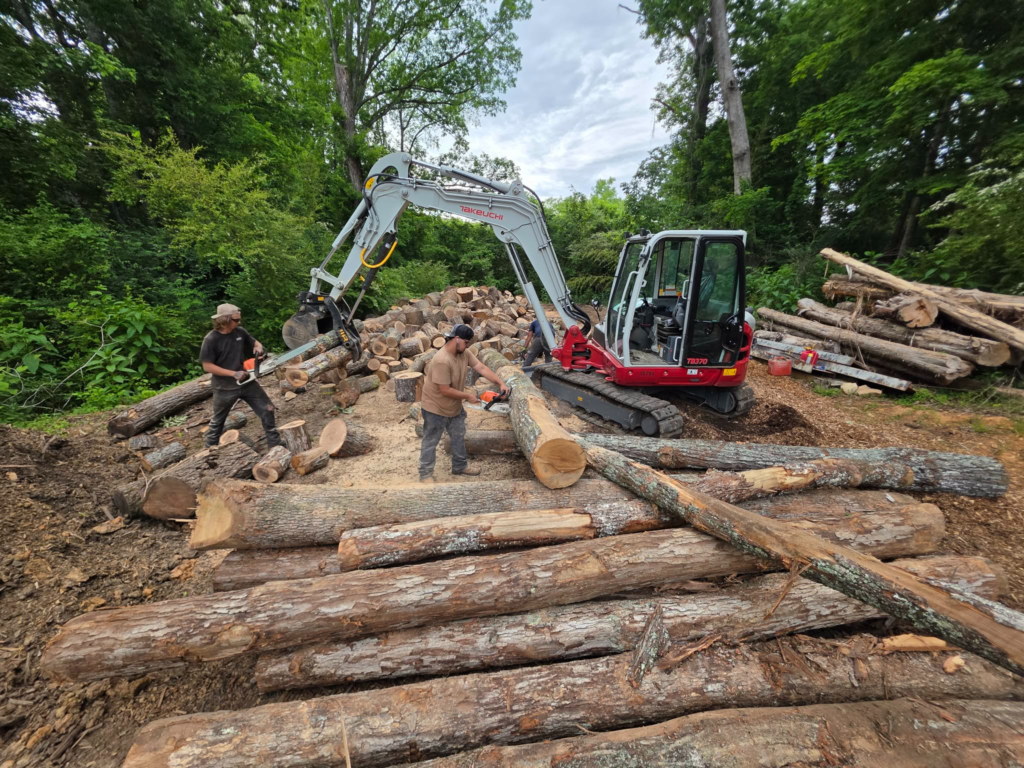
The right equipment for the job affects both safety and how much collateral damage the removal causes to your lawn and landscaping. A good residential tree service should be able to explain how it plans to complete your specific job before quoting.
Depending on the tree and site, equipment may include:
- Bucket trucks for reaching upper canopy where climber access is limited
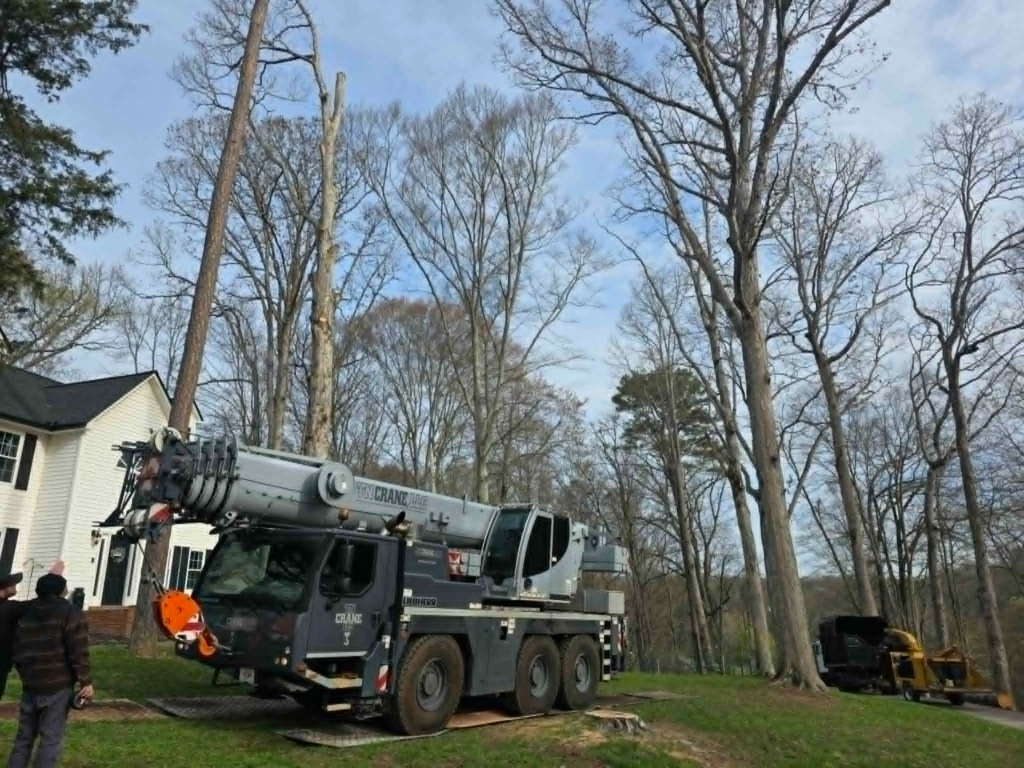
- Cranes for large trees hanging over structures or with no safe drop zone
- Wood chippers sized appropriately to the brush volume
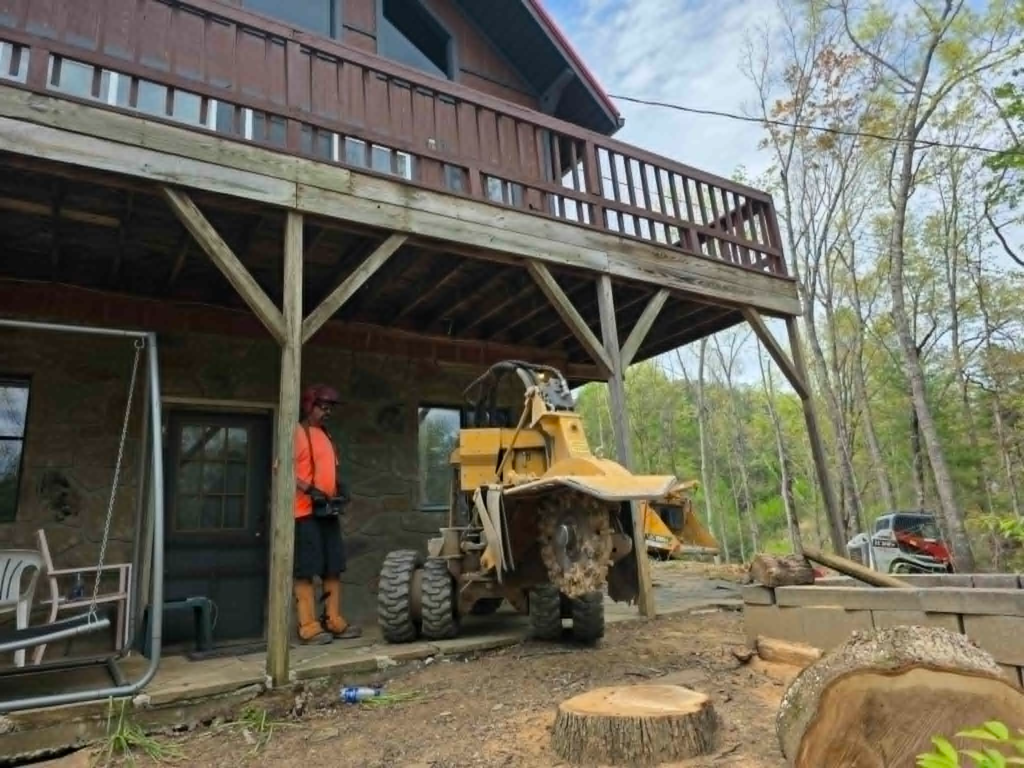
- Stump grinders for below-grade removal after the tree is down
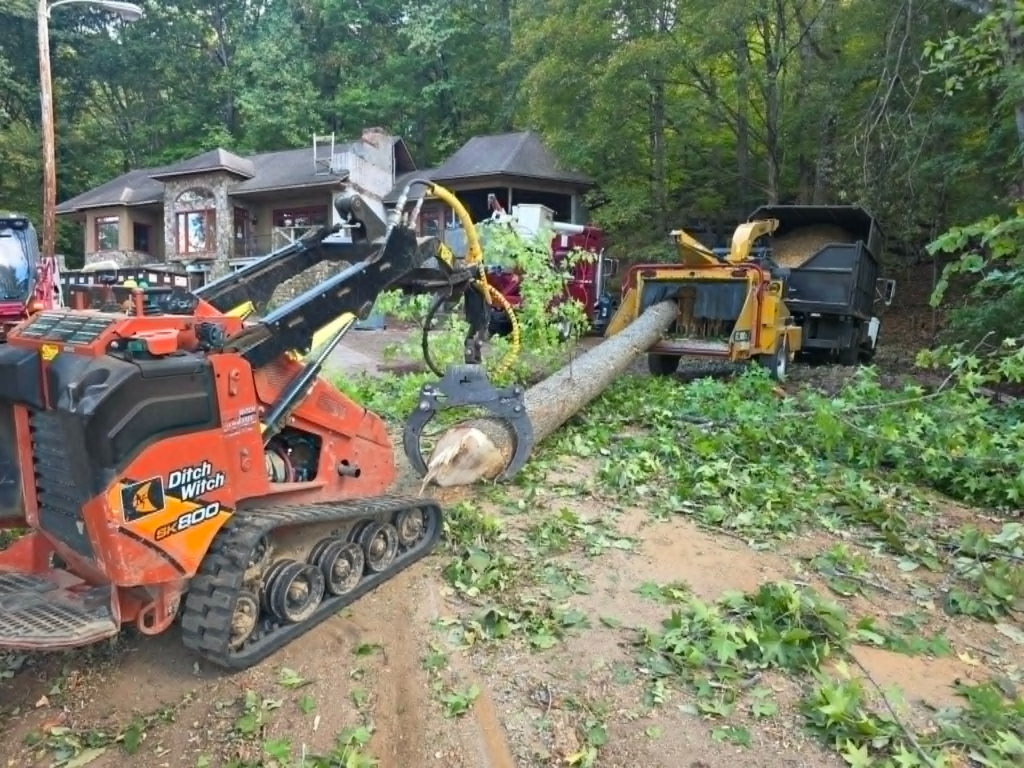
- Ground protection mats to prevent lawn ruts and compaction from heavy equipment
- Rigging systems (ropes, blocks, friction devices) for controlled lowering of sections
Ask specifically: how will you protect my lawn, my driveway, my landscaping, and my neighbor’s property?
Well-run tree removal crews lay down plywood or protection mats before heavy equipment crosses turf. They rig heavy sections down rather than letting them drop and crater the yard. They tarp flower beds and hardscape in drop zones. They stage debris where it doesn’t damage anything on the way to the chipper.
Crews that show up with no protection plan and start hammering across your lawn with a mini-skid steer are announcing their approach to your property. Neither the price nor the equipment quality will make that better.
The Warning Signs of Poor Equipment
- Trucks that clearly haven’t been maintained (leaking hydraulics, worn tires, no company signage)
- Chainsaws that need repeated on-site repair before work can start
- Equipment obviously too small for the job (a small chipper trying to process 12-inch sections all day)
- No protection materials visible on the truck
- Crew that has to leave mid-job to fetch tools or gear
Established local companies invest in the right equipment because they know what jobs they’ll face and they can’t afford to lose work waiting on repairs. Undercapitalized operators cut this corner first, and their customers absorb the cost.
Step 7: Ask About Emergency Response
If you have any concern about future storm damage, hazard trees, or fallen limbs, confirm the company’s emergency tree service capabilities before you actually need them.
Ask specifically:
- Do you offer 24/7 emergency response for storm-damaged trees?
- What is your typical response window after a major storm event?
- Are emergency call-out rates disclosed in advance, in writing?
- Do you coordinate with KUB when trees are involved with power lines?
Knoxville and the wider East Tennessee area experience severe storm systems each year, from summer thunderstorm microbursts to occasional ice loading in winter. Every major event produces a wave of homeowners searching for tree services simultaneously, and reputable local companies book solid within hours. Knowing which company you’d call before you need them is worth more than any deal you might get from a door-knocking storm chaser after the fact. Our storm damage tree emergency guide for Knoxville covers what to do in the first hours after storm damage.
Step 8: Confirm Cleanup Is Included in the Price
Cleanup is one of the largest hidden variables in tree service pricing. A comprehensive quote from a professional Knoxville tree service should cover all cleanup as part of the base price, not as a separate line item that surprises you at the end.
Before signing any estimate, confirm in writing:
- Are all branches and small brush chipped and hauled away?
- Are trunk sections and larger limbs hauled or left staged on the property?
- If firewood is requested, is it cut to a specified length and stacked?
- Are wood chips hauled, left as mulch elsewhere on the property, or dropped in a pile for the homeowner?
- Is stump grinding included, and if so, are the grindings hauled or left?
- Is raking and blowing of the drop zone included?
- Is street cleanup included if debris landed there?
Under Section 14-39 of the Knoxville code, wood waste from any tree over twelve inches in diameter is the tree company’s responsibility to haul away. Placing it at the curb for city pickup is considered illegal dumping, and legitimate tree services haul all wood waste as part of the job.
Step 9: Understand Payment Terms
Reputable tree service companies operate on standard payment norms. Any significant deviation from those norms is a warning sign worth taking seriously.
Deposits: A small deposit (typically ten to thirty percent) is acceptable for larger jobs, especially those involving specialized crane rentals or extensive coordination. Deposits above thirty percent for standard residential work are unusual.
Full payment upfront: Never acceptable for standard residential tree work. Any company demanding one hundred percent payment before starting is either desperately undercapitalized or preparing to disappear. Both are reasons to walk away.
Cash-only payment: Legitimate tree services accept multiple payment methods (check, card, sometimes financing on larger jobs). Cash-only demands, especially combined with pressure to decide immediately, are among the strongest warning signs in the industry.
Payment due on completion: The industry standard. Final payment is due after the work is done, the site is cleaned, and you’ve done a walkthrough (or been sent photos and a written confirmation).
Written change orders: Any additional work beyond the original scope should be documented in writing with an updated price before it happens. A crew that adds extras and bills you afterward is running a bait-and-switch operation regardless of how nice they seemed on the estimate.
Red Flags That Should Make You Walk Away
Certain patterns almost always signal a bad choice. Any of the following should end the conversation:
Door-to-door solicitation, especially after storms. Storm-chasing operators roll through Knox County after every major weather event knocking on doors and claiming to be “already in the area with equipment.” Legitimate local companies rarely operate this way. If someone appears at your door offering to take a tree down right now for cash, decline and get a real quote from an established company instead.
No written estimate. Verbal-only quotes leave every detail open to interpretation. Without a written scope, you have no basis for enforcing what was promised.
No proof of insurance, or only a photocopy. Any company that resists providing a Certificate of Insurance directly from its insurer is either uninsured or hoping you won’t check.
Full payment demanded upfront. A universal red flag in home services generally, and specifically in tree work.
Cash-only demands. Combined with pressure to decide immediately, this is close to a guarantee of a bad experience.
Unmarked trucks and no local address. Legitimate Knoxville tree services put company names on their trucks and operate from real physical locations. Anonymous trucks with no local presence usually mean transient operators.
Recommendations to top trees as routine maintenance. Tree topping is widely condemned in the arboriculture industry. A company that recommends topping is either uninformed or doesn’t care about tree health.
Aggressive pressure to decide immediately. “This price is only good today” is a sales tactic, not an honest business practice. Any real tree service will hold a quote for at least a week.
Vague or evasive answers about scope, cleanup, or insurance. How a company answers questions during the estimate is how it will communicate during the job. If the answers are already fuzzy, expect the job to get worse.
Not registered with the City of Knoxville Tree Maintenance Registry. For work inside city limits, this is a Section 14-39 requirement. A company that hasn’t cleared this low bar has told you something meaningful about its business practices.
Knoxville-Specific Considerations Most Homeowners Don’t Know to Ask About
Beyond the general checklist, several factors apply specifically to hiring a tree service company in Knox County that outside guides tend to miss.
KUB Power Line Coordination
Any tree within roughly ten feet of a primary distribution line (the top wires on the pole) requires coordination with Knoxville Utilities Board (KUB) before any work begins. Standard tree crews are not permitted to cut vegetation in the immediate clearance zone of energized primary lines without utility involvement.
Ask any Knoxville tree service company how it handles KUB coordination. The right answers involve advance notice to KUB, potential de-energization of the line during work, or referral to KUB’s own line-clearance crew for trees that fall in the utility’s scope. Wrong answers include “we just cut it” or “we don’t worry about the lines.” For downed trees on active power lines after storms, call KUB Emergency Dispatch at (865) 524-2911 first, before any tree company.
Tennessee 811 and Stump Grinding
Any excavation work associated with tree removal, including stump grinding, requires a Tennessee 811 utility locate ticket. A normal locate request needs three working days of notice, and the contractor doing the excavation must have the ticket in its own name.
This is standard practice for any reputable tree service in Knoxville. It also means stump grinding is sometimes scheduled as a separate visit a few days after the removal, once the 811 wait period clears. That’s a sign the company is doing things right, not a scheduling problem.
Local Species Knowledge
Common Knoxville landscape trees each have their own quirks. Red oaks and white oaks respond differently to pruning stress. Tulip poplars have brittle wood that snaps in ways other hardwoods don’t. Bradford pears fail structurally at maturity. Leyland cypress has aggressive fungal issues in our humid summers. Emerald ash borer has effectively eliminated ash trees from many yards over the last decade.
A tree service company that regularly works in the Knoxville area recognizes these patterns and adjusts accordingly. A company operating on generic national playbooks does not.
Storm Response Capacity
Knox County storms create surges in demand that overwhelm any tree company’s normal schedule. Established local companies with existing customer bases prioritize their regulars during storm events. New calls after a major event may face wait times of days or weeks.
If storm response speed matters to you (for example, if you have known hazard trees, or a house heavily surrounded by mature timber), it’s worth building a relationship with a local tree service company in Knoxville before you actually need one. That means using them for routine work first, so you’re on the phone list when the next major event hits.
Questions to Ask Before You Hire a Tree Service in Knoxville
Take this list with you when calling Knoxville tree companies for estimates:
- Are you licensed and insured, and can you have your insurer email me a Certificate of Insurance directly?
- Are you registered with the City of Knoxville Tree Maintenance Registry per Section 14-39?
- How long have you been doing tree service work in East Tennessee?
- Do you subcontract any of your work, and if so, to whom?
- Can I see recent Google reviews and photos of local jobs similar to mine?
- Which pruning standards do you follow? (Look for a reference to ANSI A300.)
- What equipment will you use for my job, and how will you protect my lawn and landscaping?
- Is stump grinding included, and if so, how deep do you grind?
- Is all debris hauled away as part of the base price?
- Do you handle any required permits or KUB coordination?
- What’s your payment schedule, and do you require a deposit?
- Do you offer 24/7 emergency response for storm-damaged trees?
- How do you handle it if the crew accidentally damages my property?
The specific answers matter less than whether the answers are direct, informed, and consistent. A tree service that fumbles these questions or gives evasive responses is showing you exactly how it will run the job.
FAQs: How to Choose a Tree Service Company in Knoxville
How do I choose a tree service company in Knoxville TN?
To choose a tree service company in Knoxville, verify current general liability and workers’ compensation insurance directly with the insurer, confirm registration with the City of Knoxville Tree Maintenance Registry (Section 14-39) for work inside city limits, get at least two or three written itemized estimates, check recent Google My Business reviews for consistent positive patterns, and confirm the company has real local East Tennessee experience with a verifiable physical address. Avoid door-to-door solicitors, verbal-only quotes, cash-only demands, and any company that recommends tree topping as routine maintenance.
Should a tree service company be licensed and insured in Tennessee?
Yes. Any tree service company operating in Tennessee should carry active general liability insurance (typically one to two million dollars in coverage) and workers’ compensation coverage. Tennessee requires workers’ comp once a business has five or more employees, but smaller crews should still carry it given how high-risk tree work is. Larger commercial projects over $25,000 may also require a Tennessee contractor’s license. Local business licensing with the City of Knoxville or Knox County applies regardless of project size, and for city work, Section 14-39 registration with the Urban Forester applies to any tree work on trees over twelve inches in diameter.
What questions should I ask before hiring a tree service company?
Before hiring a tree service in Knoxville, ask for proof of general liability and workers’ compensation insurance sent directly from the insurer, confirm City of Knoxville Tree Maintenance Registry status, ask how long the company has been in business locally, request a detailed written estimate covering scope and cleanup, ask which pruning standards the crew follows (ANSI A300 is the accepted industry standard), confirm what equipment will be used and how the property will be protected, verify whether stump grinding and debris haul-away are included, and confirm payment terms including any deposit requirements. Also ask how the company handles accidental property damage and whether emergency response is available.
Are ISA credentials required for tree service work in Knoxville?
No, ISA credentials are not required for standard residential tree service work in Knoxville. What is required for city work is registration with the City of Knoxville Tree Maintenance Registry (Section 14-39) for trees over twelve inches in diameter, plus current insurance coverage. ISA credentials from the International Society of Arboriculture are valuable for complex tree health assessments, structural risk evaluations on high-value specimens, and specialized diagnostic work, but are not necessary for routine removals, standard pruning, hedge work, or storm damage response. For most residential jobs, insurance, local experience, ANSI A300 compliance, and a strong review record predict a good outcome more reliably than any single credential.
How much should I pay upfront to a tree service company?
Standard practice in the tree service industry is either no upfront deposit, or a small deposit (typically ten to thirty percent of the total) for larger jobs involving specialized equipment such as cranes. Full payment before the job begins is not standard and is one of the strongest warning signs of an unreliable operator. Payment for standard residential tree work is due on completion of the job, after cleanup and a walkthrough. Any additional work beyond the original scope should be documented in writing before it happens.
What are the biggest red flags when hiring a tree service company?
The clearest red flags when hiring a tree service company in Knoxville include door-to-door solicitation (especially after storms), no written estimate, refusal or inability to provide a Certificate of Insurance directly from the insurer, cash-only payment demands, pressure to decide immediately, full payment demanded upfront, unmarked trucks with no local address, no registration with the City of Knoxville Tree Maintenance Registry, and recommendations to top trees as routine maintenance. Any single one of these is worth walking away over. Multiple appearing together mean the company is almost certainly a bad choice.
How do I know if a tree service company has good Google reviews?
Look for a consistent pattern rather than isolated ratings. A tree service company with strong reviews will typically have dozens or more Google My Business reviews from real Knoxville-area customers, recent activity (multiple reviews within the past few months), specific descriptions of actual jobs done, and consistent themes across reviews (cleanup, communication, on-time arrival, fair pricing). Pay attention to how the company responds to any negative reviews: professional, accountable responses signal a well-run business. Defensive or dismissive responses signal how the company will handle a problem on your own job.
The Bottom Line: Finding the Best Tree Service Company in Knoxville
Homeowners searching for the best tree service company in Knoxville often start with price, but the factors that actually predict a good outcome are different. Insurance, local experience, honest written estimates, real Google reviews from Knoxville homeowners, appropriate equipment, and city registry compliance matter far more than the number at the bottom of any quote.
A tree service that clears all ten items on the checklist at the top of this guide is the kind of company that stands behind its work and treats your property the way you’d expect. A company that clears three or four is a company that’s counting on you not to check the rest.
Take the extra hour to verify before signing. Every year, Knox County homeowners lose thousands of dollars to uninsured accidents, poor pruning decisions, and storm-chasing scam operators. Those losses are almost entirely preventable with the vetting process outlined in this guide.
Ready to Get a Straight, Written Estimate?
Whites Tree Services has been serving Knox County, Loudon County, and Blount County since 2012. Every job is owner-operated by Chris White and his crew, never subcontracted. We’re licensed and insured, registered with the City of Knoxville Tree Maintenance Registry per Section 14-39, and we follow ANSI A300 pruning standards where they apply. Our reputation is built on 90+ five-star Google reviews from Knoxville homeowners across the greater metro area.
Whether you need tree removal, pruning, hedge and bush work, stump grinding, or emergency storm response, we provide free written estimates that spell out the full scope, cleanup, and total price before any work begins. No high-pressure sales, no cash-only demands, and no verbal quotes that turn into surprise charges later.
To schedule a site visit or request a free written estimate, call us at (423) 519-7484 or visit our estimates page. We’ll walk your property, talk through what needs to happen, and give you a straight answer with a written price you can compare against any other quote you’re weighing.